
The cost of an empty desk: How much you lose on manual CV screening, and how to stop it?

Manual CV screening is now one of the biggest bottlenecks in recruitment: it slows decision-making, increases the cost of vacancies, and weakens the predictability of plan execution. The article shows how to set selection up as an operational process - make it skills-based, automate pre-screening and candidate ranking, while maintaining human control, auditability, and regulatory compliance. It also explains why an SSOT foundation is critical (integrating Recruiting with Employee Central) and how to deliver the implementation in 90 days - from cleaning up data and process statuses, through screening automation, to governance and an executive dashboard. Finally, it offers a practical next step: a quick readiness scorecard for modern HR and AI.
Poland’s current business landscape - shaped by strong wage pressure and a deepening structural skills shortage - forces executive teams to rethink the role of HR. For the Chief Operating Officer (COO) and Chief Financial Officer (CFO), recruitment is no longer a purely administrative process; it has become a critical lever for protecting EBITDA and sustaining the company’s value-creation chain.
In 2026, with the average gross monthly salary in Poland’s enterprise sector reportedly exceeding PLN 9,000,1 every day a role remains vacant represents a tangible capital drain. Based on the Cost of Vacancy (CoV) metric - which accounts for lost margin and productivity overheads - the cost of one day without a filled specialist position is estimated at PLN 1,000 to as much as PLN 4,500.
This article examines how integrated screening automation in SAP SuccessFactors Recruiting reduces decision bottlenecks by establishing a “single source of truth” (SSOT). It also addresses the information barriers discussed in the first part of the series: “Zero Data Risk: How a Single Source of Truth Protects Against Decision Paralysis.”
Challenges for the C-Suite
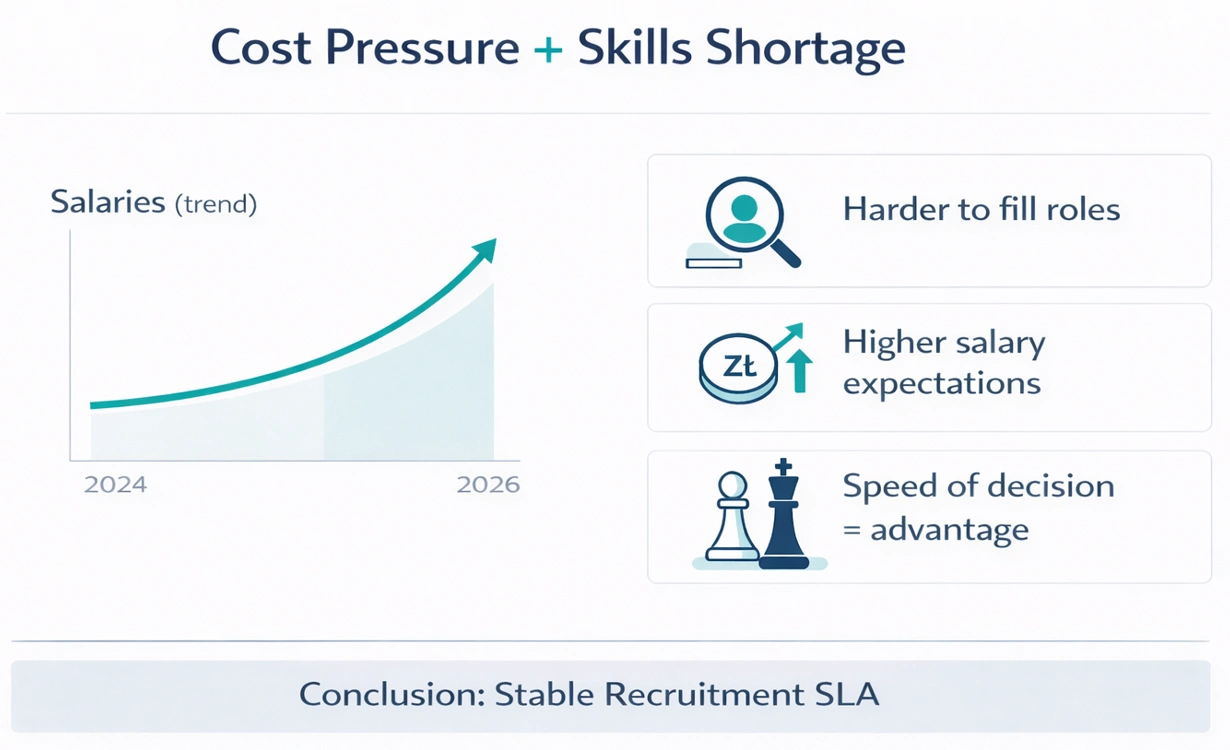
Labour market analysis in Poland indicates a “flat U” pattern in employment dynamics: companies are approaching both rapid layoffs and large-scale hiring with caution, focusing instead on precise skills matching.2 Despite this caution, as many as 86% of employers in Poland plan to run recruitment processes, driven primarily by business growth (49%) and the need to replace departing employees (35%).3
The key challenge remains wage pressure. With average gross pay exceeding PLN 9,000,4 a hiring mistake or an overly prolonged selection process, becomes a luxury modern organisations cannot afford. In addition, 58% of employers cite candidates’ unrealistic salary expectations as the main barrier to closing recruitment processes.5 The system must be able to rapidly identify applicants who not only have the right skills, but also fit within the organisation’s budget parameters.
This decision paralysis often stems from fragmented data. Organisations struggle with a lack of consistent information on headcount and FTEs, which prevents reliable workforce planning. Recruitment run separately from the Core HR system weakens management alignment, generating inconsistent reports and delaying the organisation’s response to market needs.
Risk diagnosis: The cost of a vacancy as an EBITDA drain
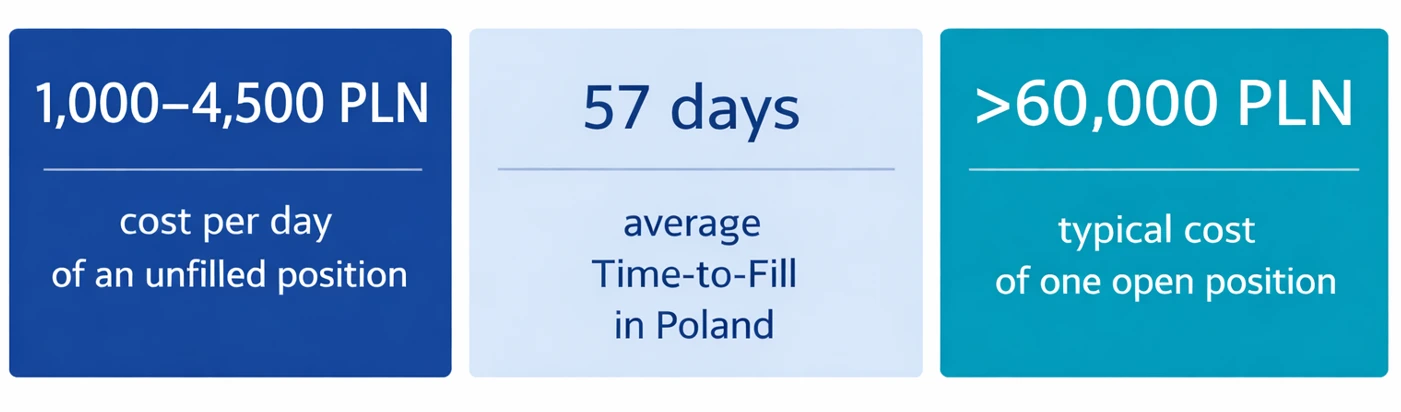
To understand the scale of the problem, we need to stop looking at recruitment through an administrative lens and start viewing it through the profit-and-loss statement. In Poland, the cost of a vacancy (Cost of Vacancy) is no longer a theoretical concept. Using a methodology that accounts for lost margin and productivity overheads,6 one day with an unfilled specialist position can cost an organisation anywhere from PLN 1,000 to as much as PLN 4,500 in high-tech sectors.
Given that the average time to fill a specialist vacancy in Poland is currently around 57 days,7 the total cost of a single open requisition often exceeds PLN 60,000. In a large organisation, the lack of automated screening - which can extend the process by an additional 10–15 days of manual document review - translates into losses running into the millions of zlotys. The Chief Operating Officer (COO) should therefore treat reducing time-to-fill as an operational initiative of the highest priority.
From paralysis to precision: A skills engine instead of “reading” paper CVs
From a professional management perspective, automation in SAP SuccessFactors Recruiting is not about “replacing people with bots”; it is about removing informational noise from decision-making. To stop the capital drain caused by “empty desks,” an organisation must move away from reactive document review and towards proactive skills-based matching.
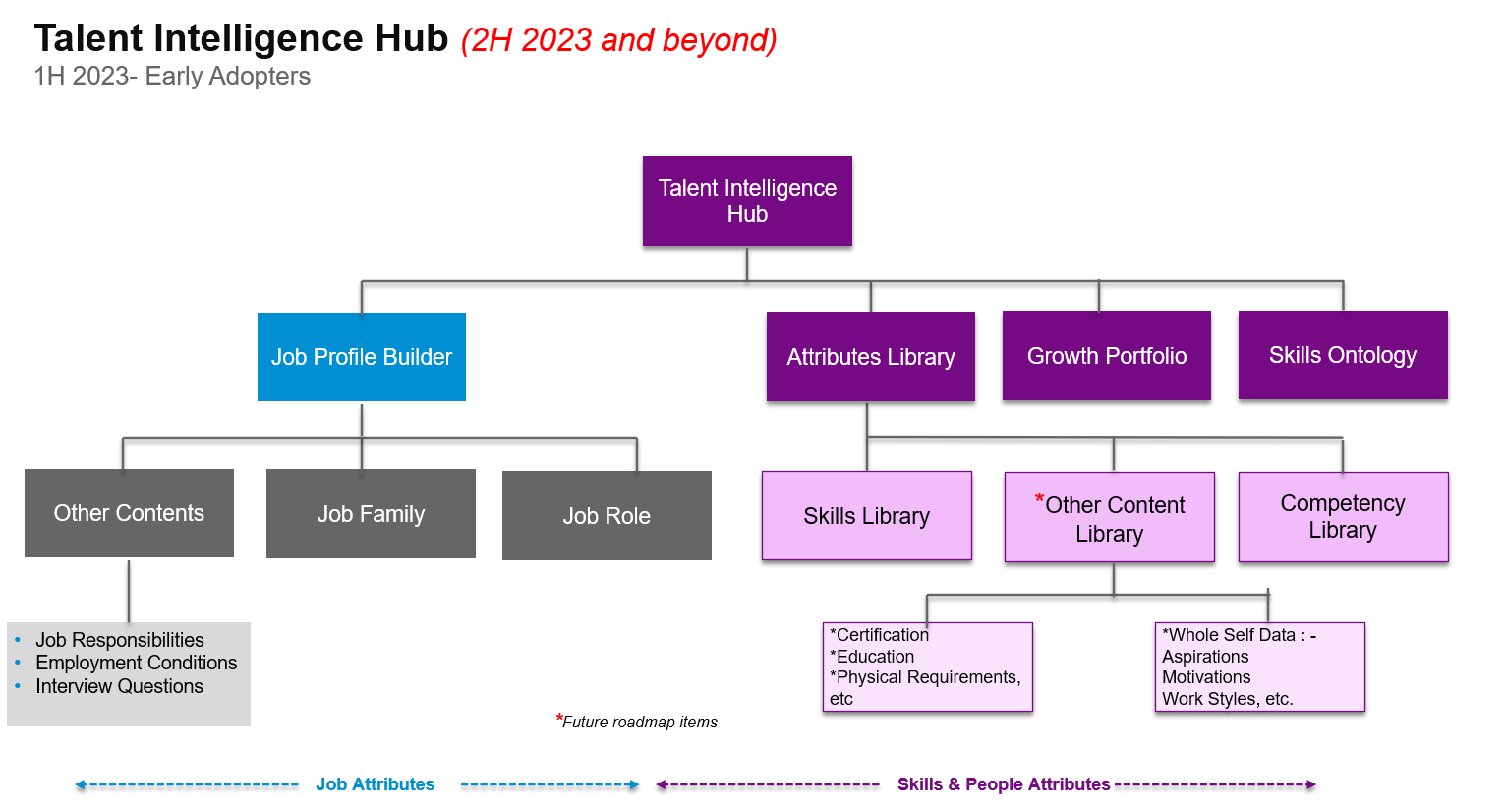
A key enabler here is the Talent Intelligence Hub - a central “skills brain” for the organisation. When integrated with Core HR (SAP SuccessFactors Employee Central), recruitment gains business context: today’s leaders are no longer looking for “someone for position X,” but for a specific set of skills that will fill a real capability gap in the team.
Intelligent screening rests on three pillars:
- Skills Matching (skills-based matching): Instead of manually reviewing 500 applications, the system ranks candidates based on the actual skills captured in their profile—not just keywords buried in a PDF.
- Knock-out Questions (pre-screening questions): Rapidly filters out applications that do not meet budget boundaries or formal requirements, protecting recruiters’ time.
- AI-assisted Screening - Joule (AI-assisted screening): The Joule AI assistant provides a precise fit ranking as early as the first day after the job is posted, allowing recruiters to focus on conversations with the strongest candidates rather than on document review.
Speed as an employer branding advantage
In a talent-scarce market, the candidate experience becomes a competitive differentiator. Automation does not mean dehumanising the process - quite the opposite. With Career Site Builder, candidates receive timely feedback and relevant job suggestions. Shortening response times significantly reduces drop-off (application abandonment), ensuring that marketing budgets spent to attract talent are not wasted due to slow, process-driven delays.
A Single Source of Truth (SSOT) as the foundation for automation
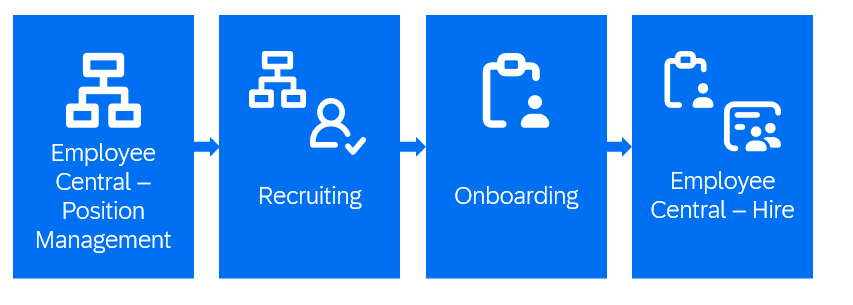
Effective screening automation is impossible in an organisation suffering from “data paralysis.” Implementing SAP SuccessFactors Recruiting fully integrated with Employee Central establishes a Single Source of Truth (SSOT) that reduces information chaos through:
- Position Management: Every recruitment process is directly tied to a position within the organisational structure. The system automatically pulls the assigned budget, skills requirements, and salary ranges - eliminating manual alignment and back-and-forth.
- Foundation Objects: Consistent definitions of business units, locations, and cost centres ensure that recruiting data matches the data used in finance and HR.
- Talent Intelligence Hub: This is where the system’s “heart” beats - unified skills model is used to define the role, assess the candidate, and later support employee development planning.
2026 Challenges: Compliance with the EU AI Act and GDPR
A Single Source of Truth (SSOT) is, in today’s environment, a prerequisite for meeting the stringent audit requirements imposed by EU regulations. From 2 August 2026, in line with the current timetable of the AI Act, key obligations begin to apply to AI systems classified as high-risk, which include solutions that support decision-making in recruitment.
It is important to note, however, that the regulation is being introduced in phases, and detailed requirements and timelines may evolve as guidance and supervisory practice develop. That is why organisations should already be preparing their process around three pillars:
- AI literacy: Employers must ensure appropriate training for staff who use AI systems.
- Transparency: Candidates must be informed that their data is being processed by an AI system.
- Human oversight: The system must allow a human to change or override an algorithmic output.
Non-compliance can result in penalties of up to EUR 35 million or 7% of global annual turnover, which for corporate groups represents a top-tier risk. In this context, deploying certified enterprise-grade solutions is a safer route for executive teams.
Automation within the SAP SuccessFactors ecosystem is designed according to the principle of compliance by design, addressing critical security and governance areas:
- Transparency and auditability: Unlike “black box” systems, the Joule AI assistant and Skills Matching mechanisms operate on clear criteria. Each recommendation is verifiable, enabling full transparency in the event of audits or candidate enquiries.
- Bias mitigation: One of the biggest risks in AI-driven recruitment is replicating human bias. SAP applies rigorous ethical standards to ensure algorithms assess candidates only on objective skills captured in the Talent Intelligence Hub -not on protected characteristics (such as gender or age).
- Data security and GDPR: Integration within SAP SuccessFactors helps ensure candidate data remains within SAP’s secure, certified cloud environment. This reduces the risk of uncontrolled data transfers outside the European Economic Area (EEA) and supports GDPR compliance -critical for protecting privacy in automated processes.
- Human oversight: In line with EU requirements, the system does not make final decisions autonomously. Its role is to provide a precise ranking and data-driven insights, while the hiring decision remains with the hiring manager.
Roadmap: 90 days to full optimisation of vacancy costs
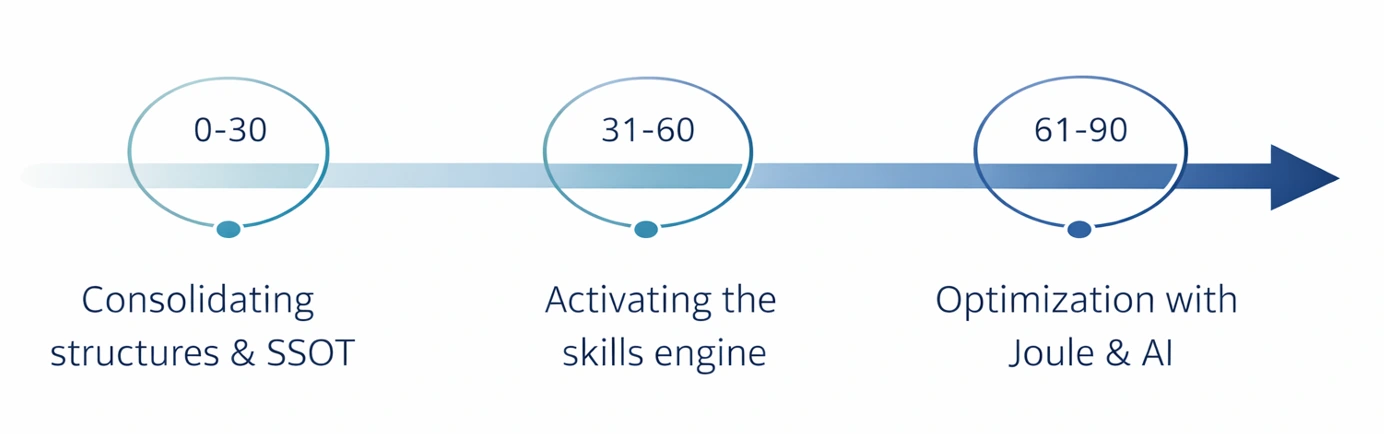
Stopping the capital drain caused by “empty desks” does not require multi-year transformation programmes. Thanks to SAP SuccessFactors’ integrated architecture, an organisation can move from data paralysis to operational precision in just one quarter:
Month 1: Consolidating structures and SSOT
Enable Position Management and tightly link recruitment processes to budget ownership in Employee Central. This is the stage where informational “noise” is removed.
Month 2: Activating the skills engine
Implement the Talent Intelligence Hub and automate skills-based screening. At this point, recruiters stop “reading” PDFs and start analysing skills fit.
Month 3: Optimisation with Joule and AI
Roll out the AI assistant for recruiters and implement real-time recruiting analytics, enabling executives to monitor how HR processes affect EBITDA.
Summary: Recruitment as an investment
As noted at the beginning of the article, every day a position remains unfilled represents a measurable loss for the organisation. Moving to a recruitment model powered by AI and a “single source of truth” shortens time-to-hire, protects margin, and builds competitive advantage in the race for scarce qualifications.
For the C-suite, automating screening in SAP SuccessFactors provides confidence that recruitment processes are fast, legally compliant, and fully aligned with business outcomes.
Is your organisation ready for recruitment in 2026?
Don’t let inefficient processes drain your budget. Complete our proprietary HCM AI Readiness Scorecard to get an immediate maturity assessment of your HR function.
Sources:
[1] GUS - Average monthly salary in the enterprise sector in December 2025
https://stat.gov.pl/sygnalne/komunikaty-i-obwieszczenia/lista-komunikatow-i-obwieszczen/obwieszczenie-w-sprawie-przecietnego-miesiecznego-wynagrodzenia-w-sektorze-przedsiebiorstw-w-grudniu-2025-r-,56,146.html
[2] Randstad - Employers’ Plans (50th edition, PDF report)
https://www.randstad.pl/badania/plany-pracodawcow/
[3] ManpowerGroup study: Talent Barometer / Talent Shortage report
https://www.manpowergroup.pl/raporty-rynku-pracy/
[4] GUS - Average monthly salary in the enterprise sector in December 2025 (including profit-sharing payments)
https://stat.gov.pl/sygnalne/komunikaty-i-obwieszczenia/lista-komunikatow-i-obwieszczen/obwieszczenie-w-sprawie-przecietnego-miesiecznego-wynagrodzenia-w-sektorze-przedsiebiorstw-wlacznie-z-wyplatami-z-zysku-w-czwartym-kwartale-2025-r-,58,49.html
[5] Hays Poland - Salary Guide 2025
https://www.hays.pl/raport-placowy
[6] Methodology: Cost of Vacancy - definition and how to calculate it
https://builtin.com/recruiting/cost-of-vacancy
[7] Recruitment KPIs
https://wyzwaniahr.pracuj.pl/blog/kpi-w-rekrutacji-wskazniki-efektywnosci-ktore-warto-mierzyc/

Ludwik Bogdański is a certified expert with more than 15 years of experience in running and implementing SAP systems integration projects, covering both client implementations and cloud projects, including SAP SuccessFactors and SAP Business Technology Platform (BTP). He specializes in the migration and transformation of SAP systems, providing the highest quality and knowledge necessary for the most complex and demanding projects. During his career, he conducted numerous trainings at SAP Training Centers in Poland and Europe, sharing practical knowledge and best practices. He currently works with the Ensis Technology team, supporting companies in the digital transformation of the HR area. Its key specializations are: • Implementation of SAP S/4HANA and SAP SuccessFactors • Project management according to SAP Activate and PRINCE2 methodologies • Integrations of SAP systems
Latest Articles
A good benefits process begins when employees don't have to ask HR what they are entitled to. They can see their own offer, know the deadlines, and understand what happens after they make a selection.
Recurring payroll adjustments are a sign that an organization is catching exceptions in data, decisions, or information flow too late. This article explores how to increase process predictability and reduce manual reconciliations before month-end closing.
Why is the question "who is available tomorrow?" largely a test of an organization's HR data quality, absence visibility, and decision-making agility? This article shows how SAP SuccessFactors helps organize employee data, absences, working time, and analytics so managers can react more quickly to changes in work schedules.