
Zero data risk: How does “one source of truth” protect against management paralysis?

The dispersion of personnel data in multiple sheets and inconsistent systems generates information chaos that often leads to decision-making paralysis at the highest levels of management. The solution to this problem is to implement SAP SuccessFactors Employee Central as a central registry, which allows you to create a “single source of truth” and unify knowledge about employment throughout the organization. Through process automation and precise business rules, the company gains a reliable analytical foundation, which is necessary for effective cost management and secure deployment of AI technologies.
Boards today must make fast decisions about people and labor costs, while acting under regulatory pressure, trade unions, and market forces. Meanwhile, in many organizations, the underlying problem is surprisingly prosaic: no one knows which HR data can really be trusted.
In this article, we show how a Single Source of Truth (SSOT), built on SAP SuccessFactors Employee Central as the global system of record (Core HR), eliminates this risk.
Which data should we base our decision on?
.webp)
Let's imagine a meeting of the board of a large corporate group.
- The CFO presents: labor cost increases 11% YoY, headcount: 10 120.
- The CHRO has other numbers on its slide: according to HR, headcount is 9 850, because employees on unpaid leave were excluded from the calculations.
- The COO presents a third set of figures. He pulls data from several systems into Excel and calculates it his own way: according to him, the company has 10 300 full-time equivalents (FTEs) - he doesn’t count people, only total working time (for example, two people at 0.5 FTE count as one FTE).
Silence follows, and the question comes up: “On the basis of which data should we make a decision on restructuring?” This is not a problem of “too few reports”. In fact, there are plenty of reports. The problem is the lack of a single, agreed source of truth about employees and organizational structure. So the solution is not to generate even more dashboards, but to define a single source of data - the Single Source of Truth - and base the entire ecosystem of HR, finance and management reporting on it. In SAP terms such foundation is SAP SuccessFactors Employee Central.
Where does decision paralysis in HR data come from?
Data fragmentation - a patchwork of systems and Excel files
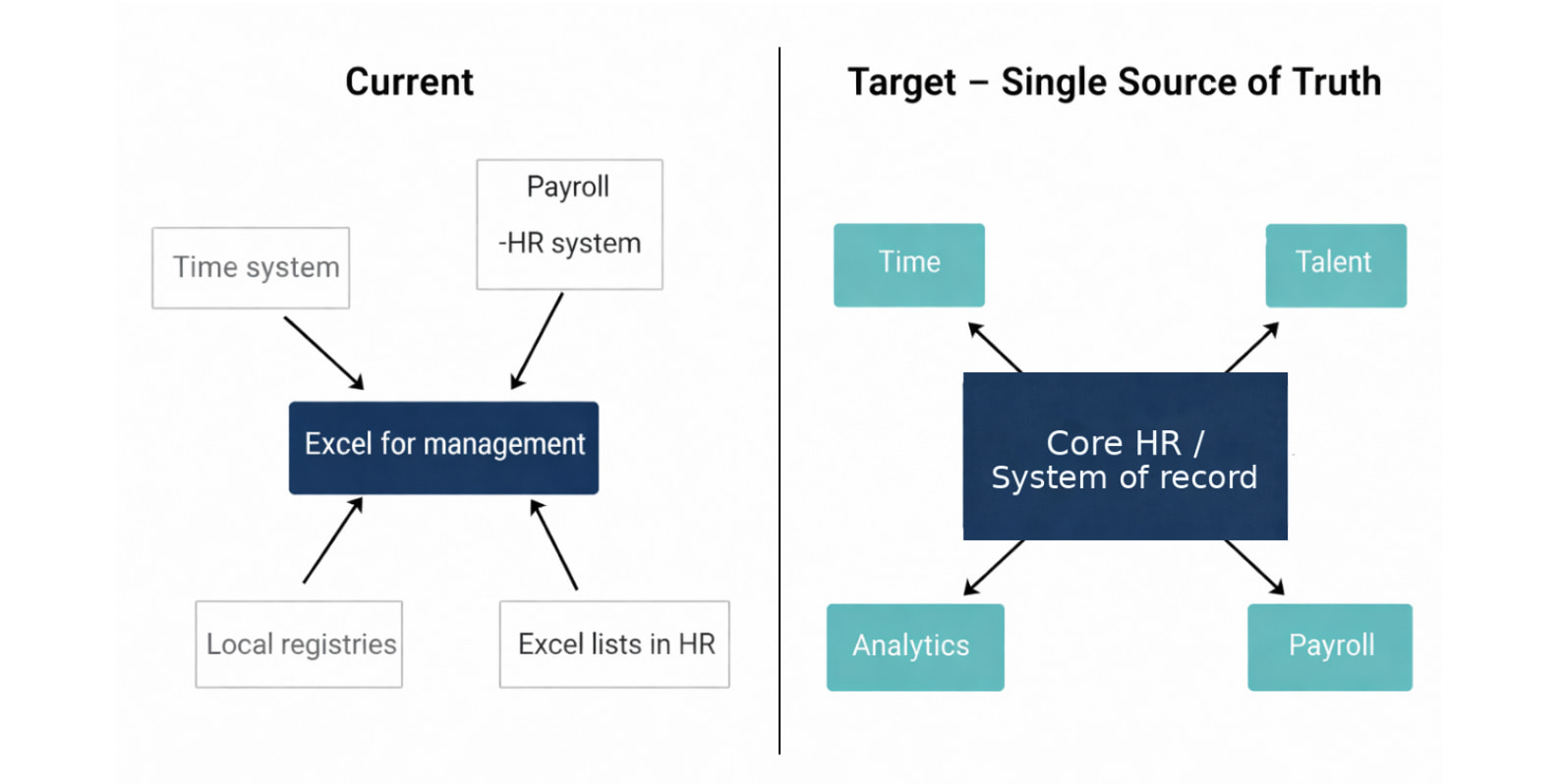
Typical landscape in a large organization or in the public sector:
- a local HR and payroll system (often several versions in different companies/units),
- separate time-tracking systems,
- Excel spreadsheets maintained by HR (projects, allowances, fixed-term contracts, employment plans),
- additional registers kept by local units (branches, institutes, schools, hospitals),
- job and organizational-structure data stored in files or on-premises applications.
The same information (e.g., number of positions, type of contract, labor costs) is present in many places, updated manually. Every presentation to the board means another round “cutting and pasting” into Excel, with an inevitable risk of errors.
Divergent definitions of the same metrics
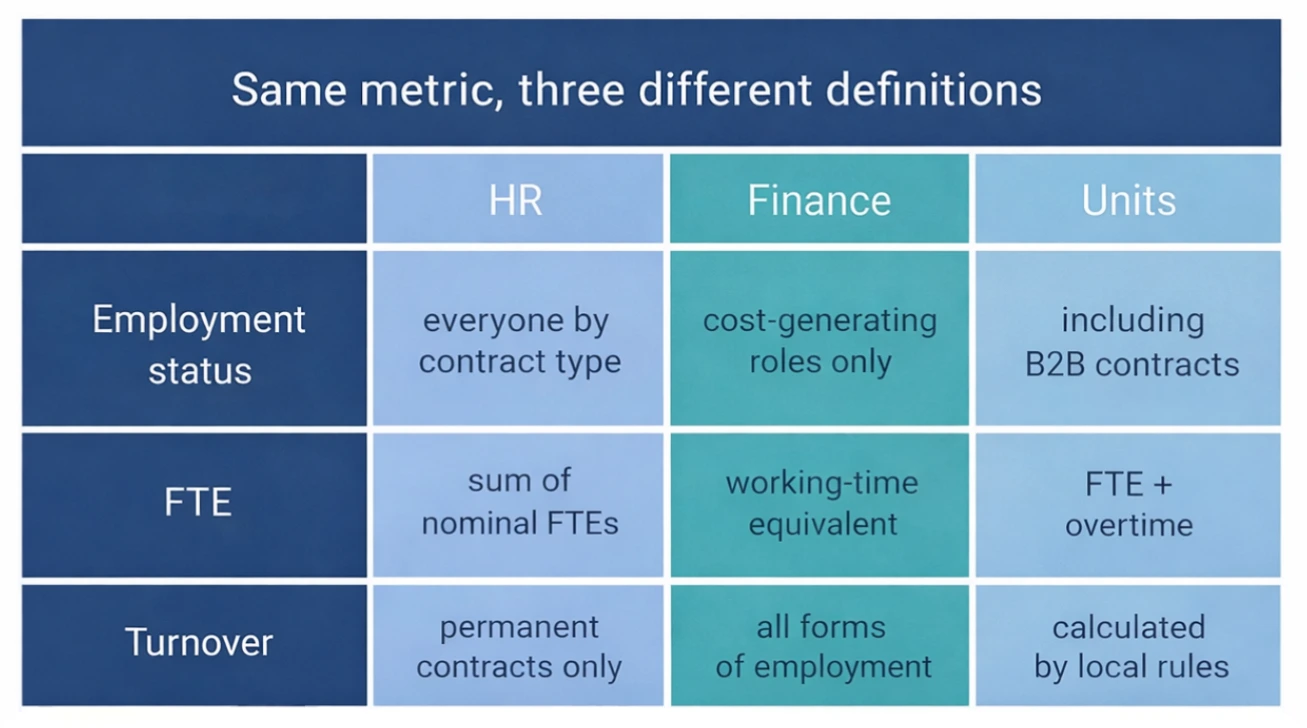
Even when the data comes from a single source, it is often counted differently:
- Employment status:
- HR: employees counted by contract type, regardless of whether they are active in the period;
- Finance: only cost-generating roles in the period;
- Local units: may also include B2B contractors or interns.
- FTEs:
- sometimes defined as total contracted hours, sometimes as working-time equivalent, and sometimes as base hours plus overtime.
- Turnover:
- permanent employees only vs. all forms of employment;
- calculated based on year-end headcount vs. average headcount.
The lack of a common data model and definition of indicators means that everyone has “their version of the truth” - and their own spreadsheet to prove it.
Consequences for the Board
This is not only a “technical” problem, but real management risk:
- Decision paralysis - meetings in which, instead of business scenarios, people debate which numbers are “real”.
- Delays - decisions are delayed, because there is no certainty about the data.
- Conflicts - HR and finance mutually question their reports; local units say that “headquarters doesn’t understand what’s really happening on the ground”.
- Risk of wrong decisions - e.g. savings planned in an area that actually has too few people anyway, or vice versa - a delayed response to rising labor costs.
What is a Single Source of Truth for HR and Management?
SSOT in the context of HR
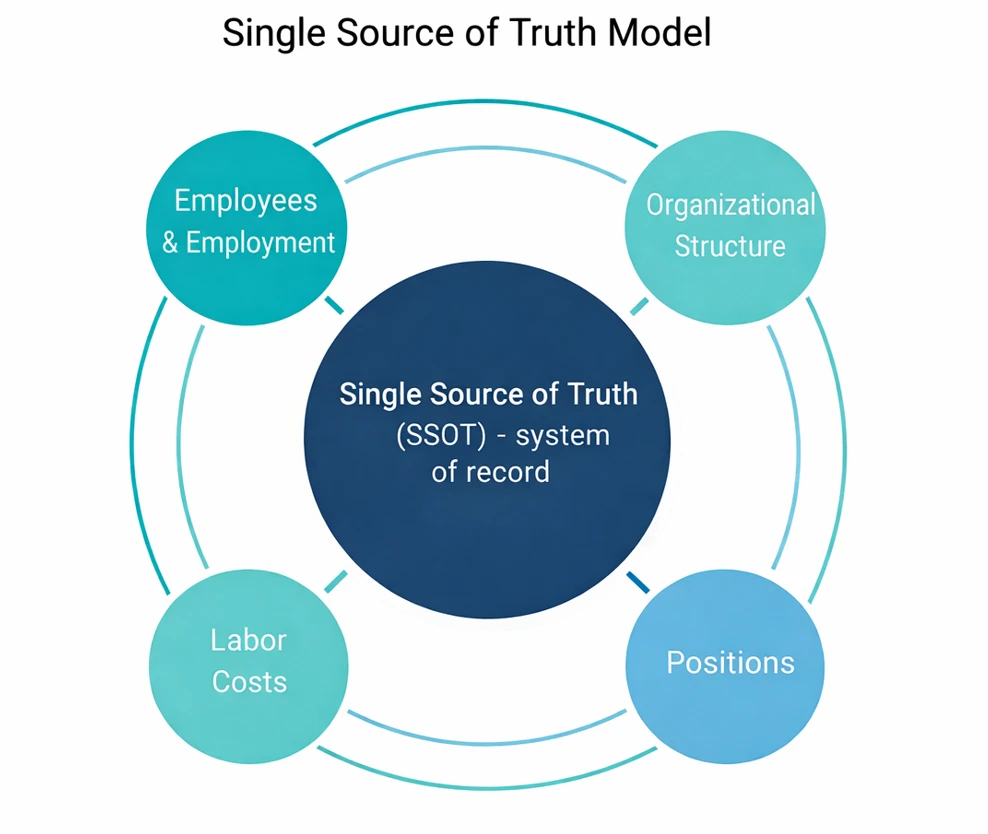
In HR, a Single Source of Truth means:
- a single, formally designated system of record for:
- data on employees and their employment,
- organizational structures (departments, units, companies, locations),
- positions and assignments of employees to positions (management of positions),
- selected data on pay and labor costs,
- where the data is:
- complete, consistent, effective-dated (you can reproduce the state as of any date),
- updated through standardized processes (workflows),
- used by other systems (wages, working time, analytics) as the reference source.
We are not talking about “another HR system” here, but central data model for employees and organizational structures, on which all management reporting is based.
What is SSOT not?
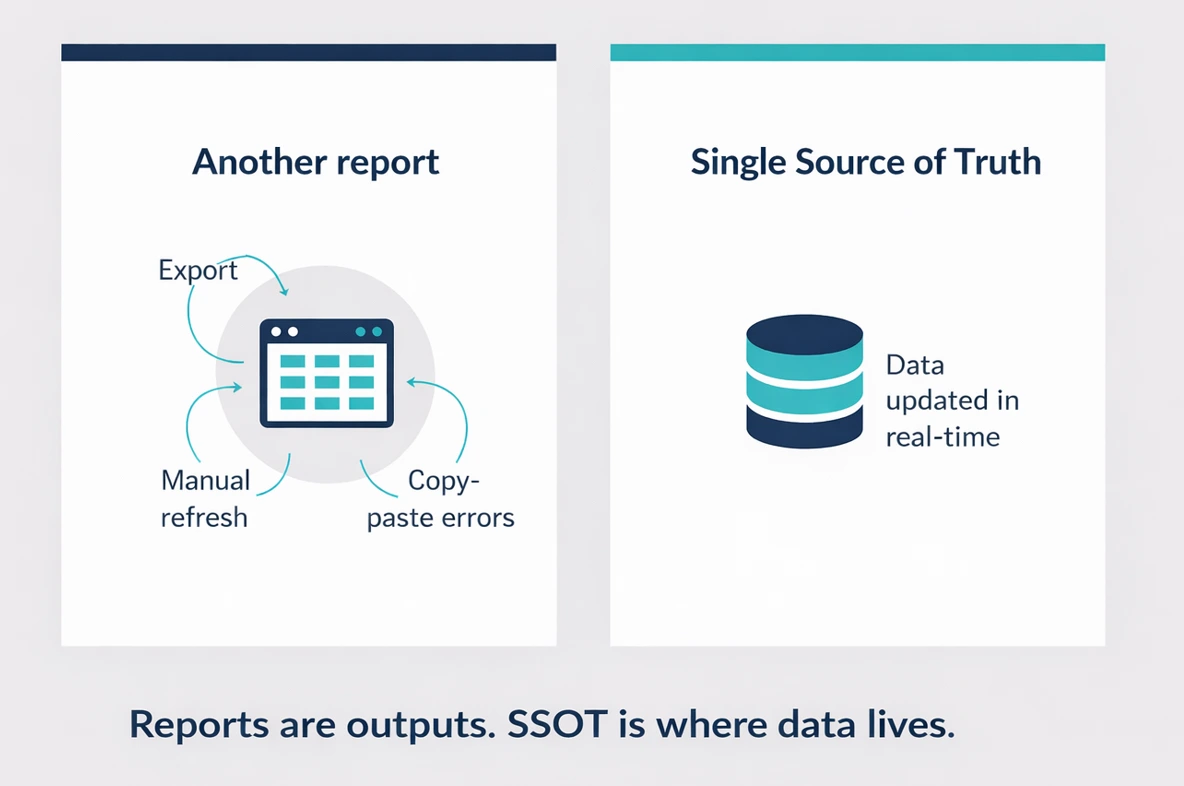
SSOT is not:
- the next Excel report, manually refreshed each month,
- a data warehouse where everyone loads extracts without common definitions,
- a one-off project: “let’s build a dashboard for the board”.
SSOT is a new way to work with HR data:
- workforce, organizational, and payroll decisions are made and executed in a system that instantly updates the “truth” about the organization,
- every change is recorded, with effective dates and an audit trail.
- other systems (wages, working time, analytics) do not “invent data from scratch” but use the same source.
Why does the board need one set of numbers?
At the executive level, the matter is simple:
- if HR, finance and business use different numbers, the board cannot make fact-based decisions - it ends up relying on narratives instead,
- if everyone refers to the same reference system, the discussion shifts to scenarios: “What do we do given these costs, risks, and market conditions?”.
In practice, a Single Source of Truth is not an IT project. It is a board-level decision that, from today on, the company will make decisions on a single, agreed picture of reality.
SAP SuccessFactors Employee Central as the foundation of Single Source of Truth
Employee Central as the global system of record (“Core HR”)
.webp)
SAP SuccessFactors Employee Central (EC) is a central HR information system (HRIS) across the entire suite of SAP SuccessFactors solutions. SAP documentation describes it as a consistent, global system of record for employee data - especially in organizations operating in many countries.
For the board, this means that:
- there is one place where the official employment record is kept,
- talent, payroll, time, and analytics tools refer to the same HR data.
Central data model: employee, position, structure
In Employee Central, data is not stored as a “flat table”; it follows a structured model:
- employee and employment data - personal information, type of employment, terms of the contract, structure of assignments (department, location, legal entity) - all with history and effective dates,
- foundation objects - objects defining the structure of the company: organizational units, locations, legal entities, job and pay structures - these are the organizational foundations of the entire system,
- position management - managing positions (filled vs. vacant), linking positions to units, budgets, and reporting lines.
Most objects are effective-dated - which allows you to reproduce employment and organizational structures as of any date (e.g., the day of a board decision taken a year ago).
Workflows and business rules: process instead of email
.webp)
It should be emphasized that Employee Central workflows are used to automate processes and ensure data quality - changes in the employee's data and in the structure follow defined approval paths and not through word of mouth.
Key elements:
- workflows:
- any significant change (employment, promotion, salary change, transfer) may require the approval of the manager, HR and even Finance,
- the system provides logic that optimizes steps (e.g., skipping duplicate approvers while keeping track of history).
- business rules:
- rules triggered when adding, changing or deleting data; they can, for example, check data completeness, limits, reasons for events, send alerts, trigger workflow processes.
In board-level terms: the quality of HR data is no longer a matter of goodwill and discipline of users - the system enforces rules, paths and consistency.
Role-Based Permissions (RBP): Access Control and Risk
The Role-Based Permissions (RBP) model, described by SAP as the SAP SuccessFactors security standard, allows you to precisely control who sees and edits certain data.
In practice:
- Employees, line managers, HR Business Partners, and global administrators each have access to different data scopes.
- Changing a user’s role automatically updates their access - no need to assign permissions individually.
This dramatically reduces the risk of '"ocal corrections" in HR data performed out of control and facilitates compliance with security and audit requirements.
Integrations with payroll, working time, talent suite and analytics
Employee Central is designed as a source system for payroll, working time and HR analytics:
- The SAP documentation shows a typical scenario: absences and attendances recorded in SuccessFactors Time Management/Employee Central and then forwarded to Employee Central Payroll or SAP HCM Payroll, where they are processed for payroll.
- Prebuilt integration scenarios for integration with time management solutions (e.g., WorkForce Software) and their connection to Employee Central Payroll are described - with a clear indication that Employee Central is the reference point for time and employee data.
- SuccessFactors talent modules (Performance, Succession, Learning and others) use data from Employee Central as as the reference for who is who in the organization and in what role.
In addition, the SuccessFactors Core HR and payroll platform provides near-real-time reporting, global location coverage and legal compliance support - which is important from the perspective of boards operating in many countries.
Mechanisms that directly reduce data risk
From a management risk perspective, the following are key:
- data versioning and effective dating - organizational structures and employment status on a specific date (important for audits, analysis of the effects of decisions),
- full audit of changes - the system records who, when and what changed in the employee's data or in the structure,
- automatic validations and alerts - rules that immediately signal errors (e.g. lack of required data, an attempt to exceed the salary range, violation of limits),
- self-service for managers and employees - updating part of the data closer to the source while controlling the rules and workflow (less manual rewriting by HR).
How SSOT Prevents Decision Paralysis: Key Scenarios
.webp)
Restructuring and labor cost reduction
Without SSOT:
Restructuring begins with... a dispute over numbers. Each company has its own report on staffing, FTEs, and allowances. Data consolidation drags on for weeks, and management is still unsure which version is correct.
With Employee Central as SSOT:
- The board sees a single, consistent view of employment and costs - by country, company, unit, and position.
- You can run “what-if” scenarios (e.g., reduce FTEs by X% in a given business unit) using verified data.
- the discussion focuses on business impact, not the reliability of spreadsheets.
Expansion into new markets
Without SSOT:
It is difficult to answer the simple question: “do we have the resources internally to open a new branch or do we need to recruit locally?” Data on skills, roles, and workforce availability is scattered.
With Employee Central as SSOT:
- A global report shows where skills are located across the organization, in which employment types, and in which roles/positions.
- Scenarios can be modeled (internal transfer/redeployment, relocation, or recruitment), including costs and impact on existing units.
- The decision to enter a new market is based on a clear talent and cost picture - not on impressions.
Automation and outsourcing
Without SSOT:
The company does not have a complete picture of which roles and costs are tied to a given process (e.g., administrative support). The data is spread across multiple systems and files.
With Employee Central as SSOT:
- Positions and incumbents are linked to the organizational structure and processes.
- You can calculate the true cost of work in the area targeted for automation or outsourcing.
- The board can make decisions based on a process-level P&L, not rough estimates.
Planning the succession of key roles
Without SSOT:
Data on who actually performs which role can be inconsistent (matrix structures, multiple contracts, temporary assignments). The succession system does not always have up-to-date data.
With Employee Central as SSOT:
- There is a single model of positions and incumbents that feeds succession planning.
- The board can see which key roles are most critical - where there is no identified successor and where people and cost risk is highest.
- You can simulate staffing changes and assess their impact alongside labor costs.
HR data management - what needs to change for SSOT to work
.webp)
The role of CHRO and the Board
Single Source of Truth will not happen “from the bottom up”. It requires a decision by the board and the CHRO to:
- designate a specific reference system for employee data (Employee Central),
- agree on common definitions for key indicators (headcount, FTEs, employee turnover, vacancies, labor costs),
- treat HR data quality as a component of organizational risk, rather than as an “HR operational issue”.
Data owners, standards, policies
For SSOT to work in practice, you need:
- data owners in HR and the business, clearly assigned to specific domains (e.g., organizational structures, positions, compensation data),
- a documented glossary of concepts and indicators, consistent across HR, finance, and the business,
- standards for maintaining structures and positions, reflected in Employee Central configuration (foundation objects, position management, and job/pay structures).
Use Employee Central to monitor the quality and consistency of HR data
Technology plays a very practical role here:
- Workflows ensure changes go through the appropriate approval steps (managers, HR, and sometimes Finance or Compliance).
- Business rules ensure data is complete and aligned with policies (e.g., salary ranges, time limits).
- Role-based permissions (RBP) limit who can make changes, reducing the risk of unauthorized modifications.
This makes HR data governance not a “SharePoint document,” but a living mechanism built into the HR system.
HR, IT, and Finance Collaboration
SSOT requires close collaboration across three functions:
- HR: defines data logic, processes, roles, and responsibilities.
- IT: ensures integrations (payroll, time and attendance, financial systems, data warehouses) treat Employee Central as the source of truth, rather than just one of many local sources.
- Finance: co-defines key metrics and ensures management reporting uses the same definitions and underlying data as HR.
Checklist for the Board and CHRO
Finally, a few questions to ask at board level:
- What system is formally designated as the reference system for workforce and organizational structure data?
- How many times is HR data manually re-entered or exported to Excel before a board meeting?
- Are the definitions of key indicators consistent and documented across HR, Finance, and the business?
- Can we reconstruct workforce and structure data as of a specific date from one or two years ago - for audit purposes or to assess decision impacts?
- What data validation and audit mechanisms does our core HR system provide - and are they actually used?
- Do all key changes (hires, promotions, pay changes, transfers) go through workflows and business rules, or are they still managed via email?
- How often does the board challenge HR data during meetings?
Conclusion: One shared picture of reality
Without a Single Source of Truth, every board decision about people -restructuring, expansion, automation, salary budgeting - carries hidden data risks. Uncertainty about the numbers leads to:
- decision paralysis,
- endless disputes between functions,
- a real risk of wrong decisions.
SAP SuccessFactors Employee Central is a global reference system and core HR data platform. It provides a solid foundation to eliminate this risk: a consistent data model for employees and organizational structures, efficient workflows, business rules, a robust permissions model (RBP), and prebuilt integration scenarios with payroll, time, and analytics.
If your last board meeting spent more time reconciling data than choosing a scenario, this is a good time to ask:
Isn’t it time to establish a Single Source of Truth built on SAP SuccessFactors Employee Central and free management from the risk of bad data?
Next step: Interactive assessment - HCM AI Readiness Scorecard
If you want to turn this reflection into a concrete action plan, start with a short, interactive assessment: the HCM AI Readiness Scorecard.
This is a short, structured assessment that takes just a few minutes and helps you:
- assess how ready your HR data and processes are to serve as a single source of truth,
- check whether the foundations for using AI in HCM are strong enough,
- identify specific gaps and priorities.
Instead of another general presentation, you get a specific maturity map - a starting point for board-level discussion.
Take the assessment and check your score → HCM AI Readiness Scorecard

Ludwik Bogdański is a certified expert with more than 15 years of experience in running and implementing SAP systems integration projects, covering both client implementations and cloud projects, including SAP SuccessFactors and SAP Business Technology Platform (BTP). He specializes in the migration and transformation of SAP systems, providing the highest quality and knowledge necessary for the most complex and demanding projects. During his career, he conducted numerous trainings at SAP Training Centers in Poland and Europe, sharing practical knowledge and best practices. He currently works with the Ensis Technology team, supporting companies in the digital transformation of the HR area. Its key specializations are: • Implementation of SAP S/4HANA and SAP SuccessFactors • Project management according to SAP Activate and PRINCE2 methodologies • Integrations of SAP systems
Latest Articles
A good benefits process begins when employees don't have to ask HR what they are entitled to. They can see their own offer, know the deadlines, and understand what happens after they make a selection.
Recurring payroll adjustments are a sign that an organization is catching exceptions in data, decisions, or information flow too late. This article explores how to increase process predictability and reduce manual reconciliations before month-end closing.
Why is the question "who is available tomorrow?" largely a test of an organization's HR data quality, absence visibility, and decision-making agility? This article shows how SAP SuccessFactors helps organize employee data, absences, working time, and analytics so managers can react more quickly to changes in work schedules.