

In many large companies, goals “exist.” The problem is they don’t steer anything. Sales delivers growth, Finance cuts costs, IT manages risk, HR does its part - everyone acting in good faith. As a result, strategy gets diluted in day-to-day priorities, negotiations, and delayed decisions. This article shows how to close that gap: goals aligned across levels, a regular cadence of short progress reviews, and comparable evaluation rules that limit subjectivity. It also provides a practical implementation blueprint for large organizations: what to measure in the first 90 days, where to run a pilot, how to build manager adoption, and how to report in a way that lets the CHRO, CFO, and CIO see the same picture and make consistent decisions.
In many organizations, goals “exist” on paper, but in practice they take on a life of their own. Sales chases growth, Operations pursues stability, Finance focuses on cost cutting, IT prioritizes security and standards, and HR drives development and engagement. Everyone is right, but those “rights” are not connected into a single, coherent system of priorities.
That’s exactly the Hydra of Conflicting Goals. The harder you try to “silence” it, the faster new heads grow back in the form of local KPIs, project objectives, and well-justified exceptions. The business outcome is predictable: competing priorities, blurred accountability, delayed decisions, and people doing a lot of work… just not necessarily the work that matters most.
Conflicting goals are a management cost. A well-designed goal management system reduces the chaos by linking priorities with accountability and measurable progress. If you want to see how a “single source of truth” brings order to executive decision-making and reduces the risk of data-driven mistakes, read: Zero Data Risk: How a “Single Source of Truth” Protects You from Executive Paralysis.
A simple test
Ask 10 executives to answer one question:
“What are the three most important company priorities this quarter, and how does your department support them?”
In a well-run organization, the answers will be similar. In an organization with the Hydra, you’ll get 10 different “top threes.” Each one makes sense, and all of them are impossible to deliver at the same time.
That’s why a goal management system matters: it serves as a safeguard for alignment and execution.
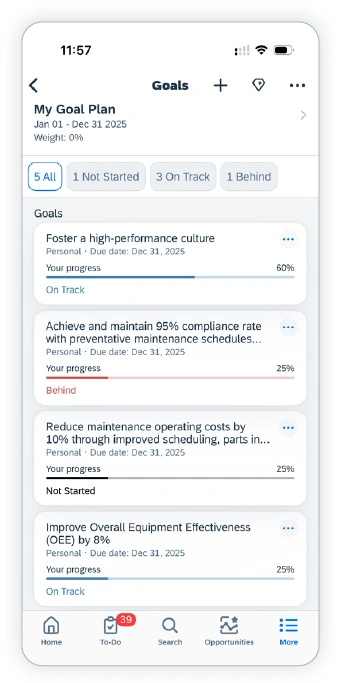
SAP SuccessFactors Performance & Goals is built for exactly this challenge. It supports different approaches to goal and performance management, while also enabling alignment across levels, cascading goals throughout the organization, and tracking progress continuously (including on mobile) - instead of revisiting the topic once a year during performance reviews.
What changes for the CHRO, CFO, and CIO
The CHRO sees it immediately: when goals are aligned and visible, performance and development conversations stop being theater. A normal operating rhythm emerges:
- shorter check-ins,
- ongoing feedback,
- coaching “in the moment,” rather than an annual “surprise in December.”
This is the right direction - moving away from rigid, yearly ceremonies toward continuous leadership of teams.
The CFO sees it in numbers (and in time):
- aligned goals mean less friction across the organization,
- less duplicated effort,
- fewer projects running “beside the priorities,”
- fewer decision delays.
A significant portion of unaccounted cost also disappears - the kind no one posts to a dedicated ledger line: alignment meetings, negotiating conflicting KPIs, and constantly defusing cross-functional tensions. When priorities are synchronized, you don’t have to “rescue” the strategy at quarter-end with expensive ad-hoc actions.
The CIO sees order in governance and data:
- goals, reviews, and feedback live in one coherent environment,
- there is one version of truth and one process,
- reporting stops being a debate about “whether the numbers match” and starts supporting decisions,
- integrations become simpler, auditability improves, and adoption becomes real.
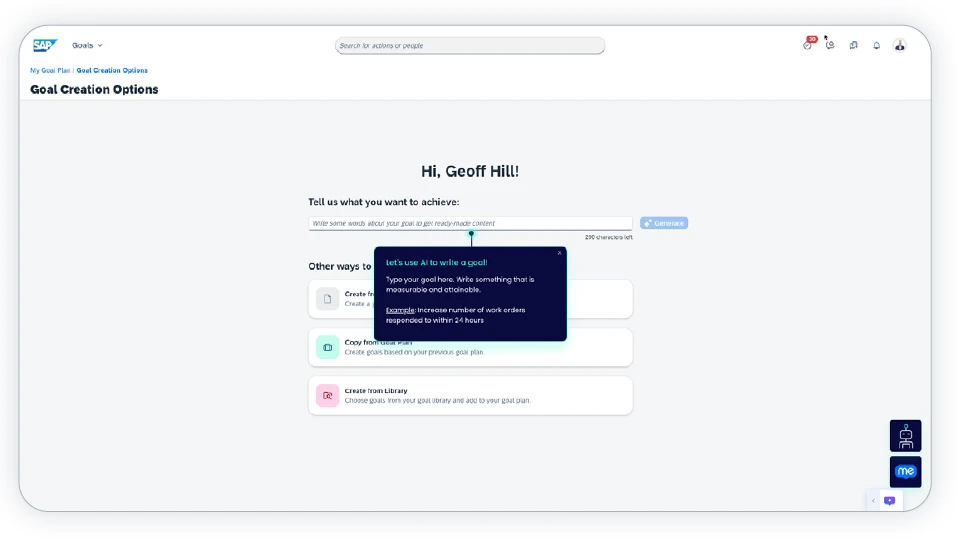
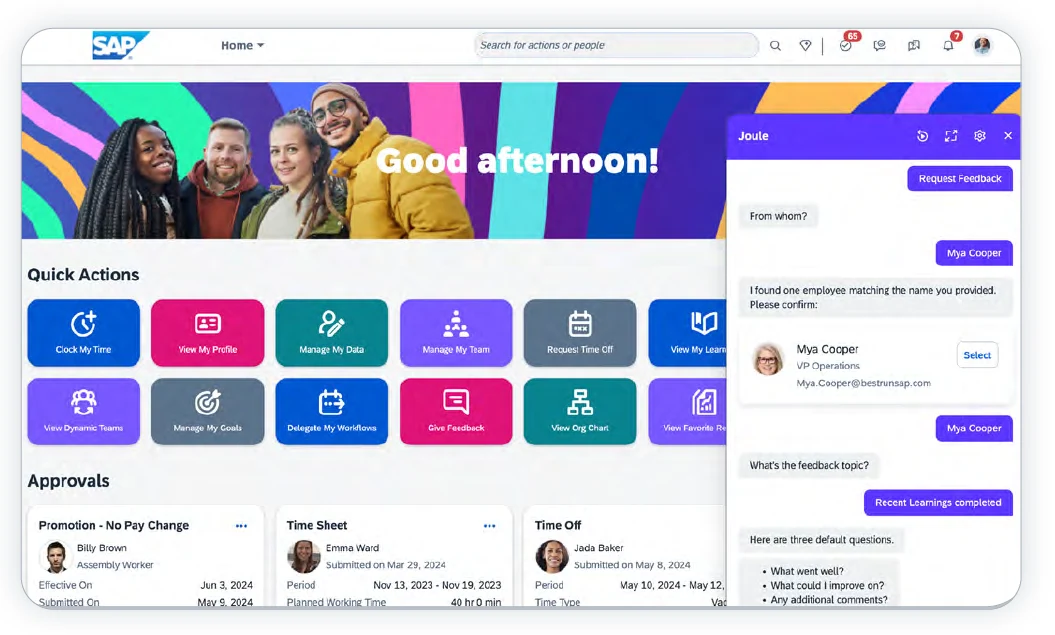
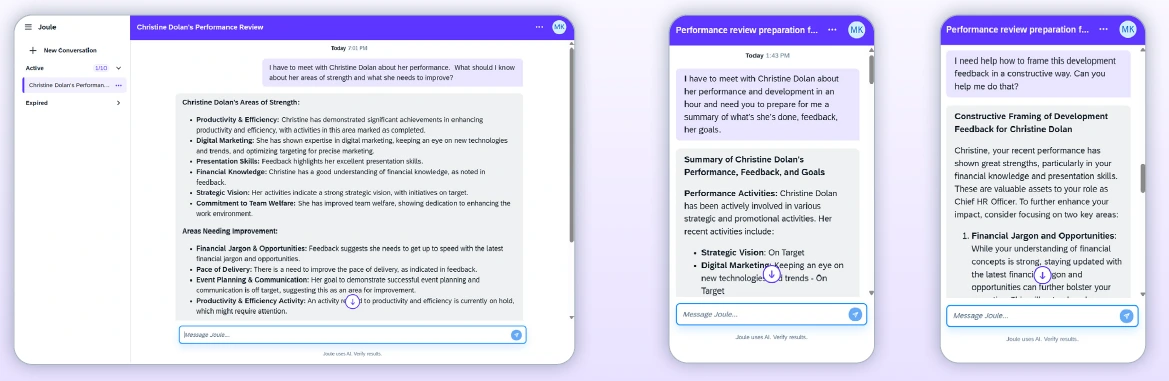
Goal work can be embedded in everyday workflows and supported by Joule, an AI assistant. By understanding business context, Joule reduces friction for users - helping them formulate goals precisely (e.g., using SMART), suggesting relevant KPIs, and automatically summarizing progress based on current activity in the system.
Goals without a system?
Most implementations start with entering goals into a tool. They should start with the operating mechanics: who sets goals, who reviews them, how often they’re adjusted, and what evidence tells us the process is working.
A goal operating model has three parts:
1. A clear goal architecture
Define:
- how many levels you have (company -> domain -> team -> individual),
- how cascading and linking work,
- what is “must-win” (strategic priorities) versus “business as usual.”
SuccessFactors allows you to cascade goals and immediately check whether they are linked to strategy (e.g., via an alignment view). This makes it easier to spot the classic situation where a team is “delivering”, but not what is currently most important.
2. Operating rhythm, not a one-off exercise
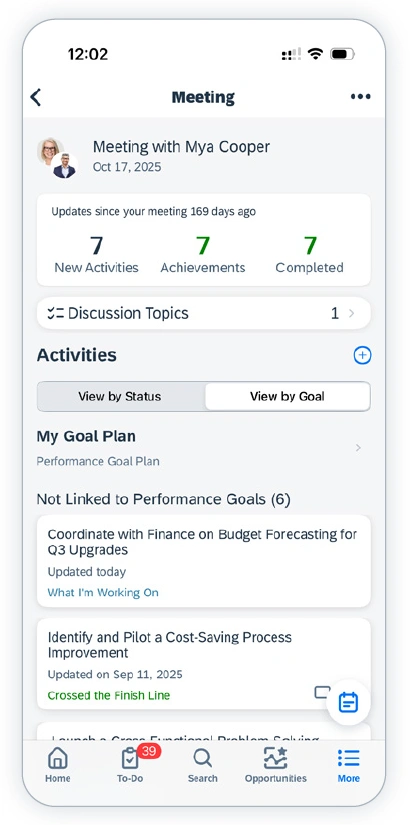
Goals must live in a cycle: set -> review -> adjust -> summarize. A continuous performance approach works here: ongoing comments, capturing achievements, short 1:1s, and feedback “in the moment,” not after the fact -in other words, real-time coaching and continuous feedback. The same lack of rhythm and enforcement shows up in onboarding. If responsibilities aren’t automatically tracked and followed through, costs and delays increase in the first 180 days - see: Onboarding 0–180: How to Regain Control Over Costs and Post-Hire Delays.
3. Consistency of evaluation and decisions (yes - the CFO must like it, too)
If performance evaluation is “soft” and not comparable, frustration rises and the risk of unequal treatment increases. That’s why the following elements matter:
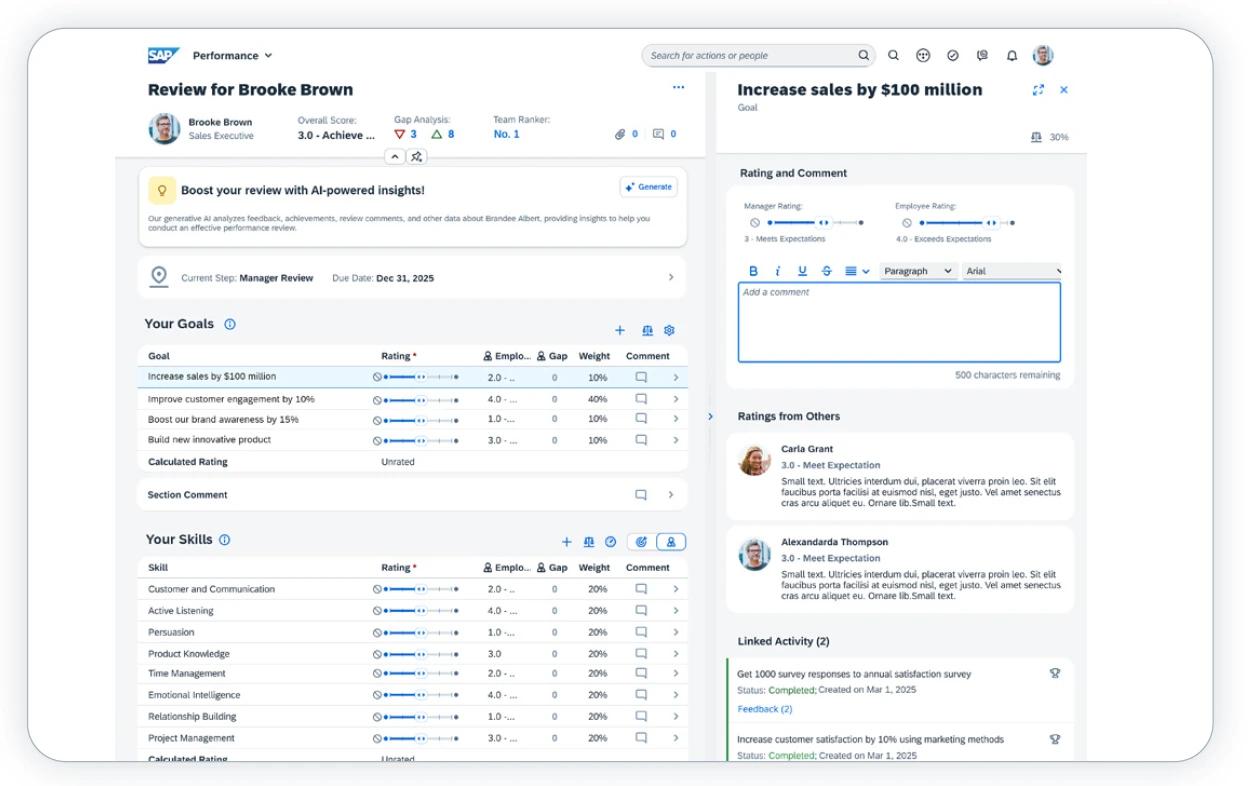
- calibration of ratings (standardizing performance levels),
- comparing ratings and data (goal/competency ratings, review scores),
- business rules that increase transparency and reduce randomness in the process.
Implementation approach
Implementing goal management starts with defining operating rules: how goals are set, how often you return to them, how progress is measured, and what rules the evaluation process follows. Only then does the system make sense, because it enforces discipline and ensures alignment at scale.
1. Define success criteria for the first 90 days
Start with 2–3 implementation metrics that show whether the organization is moving from “declaring goals” to actually managing them. For example:
- share of goals linked to higher-level goals (alignment),
- share of managers running quarterly progress reviews,
- reduced time required to prepare review conversations because progress and achievements are captured continuously,
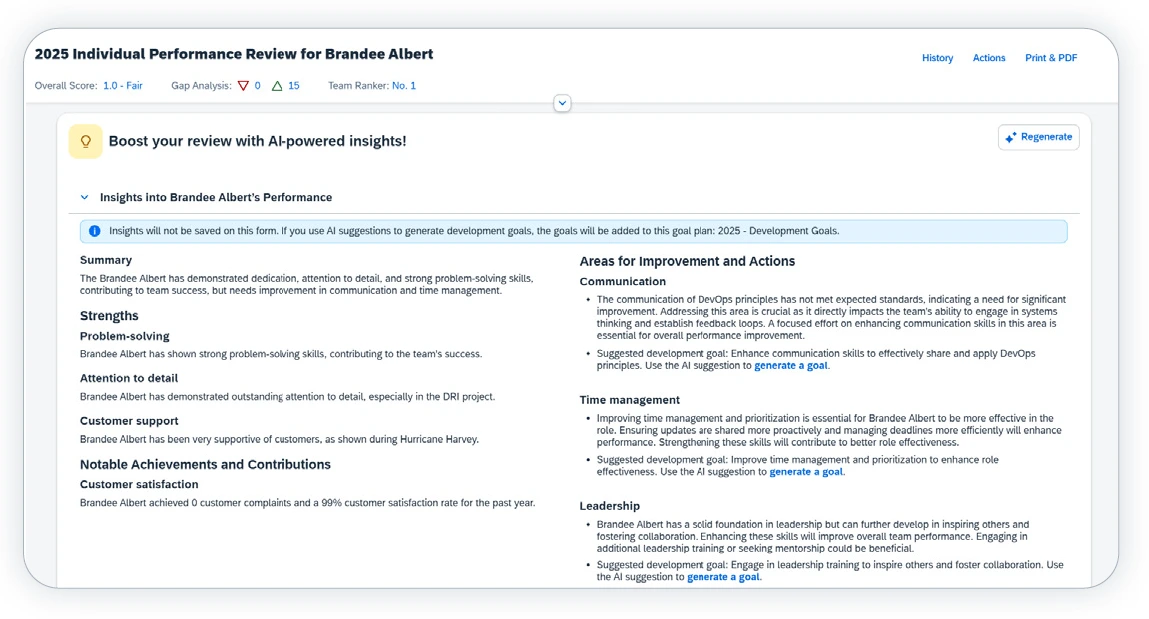
- improved quality of goal wording (measurability, timeliness, coherence), supported by AI features for drafting and editing.
2. Standardize priorities and the goal definition format
Regardless of the tool, you need one source of priorities (company and domain levels) and a shared standard for how goals are written. The minimum standard should include:
- goal statement,
- metric / success criteria,
- due date,
- owner,
- link to a parent goal,
- optional weight.
SAP SuccessFactors supports both goal cascading and goal linking, and it helps users create goals (including with AI-assisted capabilities).
3. Pilot in an area with real cross-functional dependencies
The pilot should cover a unit where cross-functional dependencies are strong - that’s where you’ll see fastest whether goals are truly aligned and whether the mechanism works. Success also requires clear sponsorship and the ability to make quick adjustments based on the first weeks of real usage.
SuccessFactors provides tools for tracking goal alignment and monitoring progress, helping identify misalignment between execution and priorities.
4. Treat manager adoption as the primary implementation priority
The biggest implementation risk is that the tool becomes “seasonal,” used only during annual reviews. That’s why you need an operating cadence (monthly/quarterly) and you must reduce friction for managers. In practice, this means:
- working in the manager’s natural environment (e.g., Microsoft Teams integration),
- mobile access for quick actions “on the go,”
- guided adoption through in-process support (e.g., WalkMe).
5. Process rules, workflow, and calibration
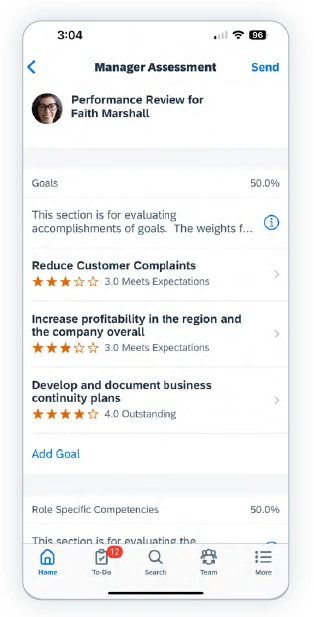
Consistent evaluation rules are essential to reduce discretion and the risk of disputes about fairness. SuccessFactors supports calibration, work on comparable data (e.g., goal achievement ratings, competency ratings, review outcomes), and the use of business rules to standardize process flow.
6. Reporting that connects HR and business perspectives
In a mature goal management model, reporting cannot stop at “HR metrics.” SAP points to a People Intelligence approach in SAP Business Data Cloud, where HR and business data can be analyzed together via dashboards and AI-supported insights with Joule.
This is the stage that changes the conversation from “does this tool make sense?” to “where is the risk of missing priorities, what is driving it, and what decisions do we need to take?”
Summary: The Hydra won’t die from presentations
As noted at the start, conflicting goals are a management cost. In large organizations they show up in three places: lower productivity (cross-functional friction), delayed decisions (lack of clear priorities), and risk of missing strategy execution (goals don’t add up to a shared outcome).
A mature goal management system reduces this cost by introducing a coherent operating mechanism: goals are embedded in one priority model, linked across levels, reviewed on an operating cadence, and evaluated with comparable rules.
For the CHRO, this means moving from an annual review ceremony to continuous leadership: shorter, more frequent conversations, higher-quality feedback, and more predictable talent and development decisions.
For the CFO, it means real savings in organizational friction: less duplicated effort, fewer off-priority projects, faster decisions, and lower cost of quarter-end “strategy rescue” actions.
For the CIO, it means process and data order: one environment for goals and performance, one version of truth, stronger auditability, simpler integrations, and higher adoption through embedding the work in everyday workflows.
Manager-supporting technologies can reduce preparation time and raise the quality of the entire process (from goal wording to review conversations). But the prerequisite is clear standards first: a shared goal format, a review cadence, and consistent evaluation rules. Then you get a tool that truly simplifies work rather than adding another administrative layer.
Check your HR maturity level and what is blocking strategy execution today. Complete the HCM AI Readiness Scorecard (7 areas, 7 minutes). You’ll receive your maturity level and recommended actions for the next 6–12 months.
Start the assessment: HCM AI Readiness Scorecard

Ludwik Bogdański is a certified expert with more than 15 years of experience in running and implementing SAP systems integration projects, covering both client implementations and cloud projects, including SAP SuccessFactors and SAP Business Technology Platform (BTP). He specializes in the migration and transformation of SAP systems, providing the highest quality and knowledge necessary for the most complex and demanding projects. During his career, he conducted numerous trainings at SAP Training Centers in Poland and Europe, sharing practical knowledge and best practices. He currently works with the Ensis Technology team, supporting companies in the digital transformation of the HR area. Its key specializations are: • Implementation of SAP S/4HANA and SAP SuccessFactors • Project management according to SAP Activate and PRINCE2 methodologies • Integrations of SAP systems
Latest Articles
A good benefits process begins when employees don't have to ask HR what they are entitled to. They can see their own offer, know the deadlines, and understand what happens after they make a selection.
Recurring payroll adjustments are a sign that an organization is catching exceptions in data, decisions, or information flow too late. This article explores how to increase process predictability and reduce manual reconciliations before month-end closing.
Why is the question "who is available tomorrow?" largely a test of an organization's HR data quality, absence visibility, and decision-making agility? This article shows how SAP SuccessFactors helps organize employee data, absences, working time, and analytics so managers can react more quickly to changes in work schedules.