

The lack of consistent onboarding in the first 180 days is a hidden operational cost that manifests as high turnover, delayed time-to-proficiency, and decision-making chaos. When the process relies on institutional memory and Excel spreadsheets, the organization loses control over execution, forcing managers to patch systemic gaps at the expense of their own productivity. This article frames onboarding as an operational mechanism built on rigid timeframes, clearly defined roles, and strict accountability in task execution. In this context, SAP SuccessFactors Onboarding integrated with Employee Central as the "single source of truth" - transcends its role as a mere IT system to become a tool for true strategic execution. It transforms soft claims into hard data, eliminating bottlenecks and ensuring full auditability, even in highly regulated sectors. Through this approach, the 0–180 day onboarding journey evolves from a series of ad-hoc HR activities into a predictable process that mitigates risk and yields tangible cost savings post-hire.
In many companies, onboarding looks great on paper. There’s a welcome, a presentation, and an email with links. Then reality hits: no access, unclear expectations, a manager “when I find time,” a buddy “when I remember,” HR “when I can get to it.” After a month, nobody goes back to the checklist because the business is running on whatever is most urgent that week.
And that’s the point: onboarding set up as a set of activities rather than a process doesn’t give you control especially when scale, speed, and delivery pressure increase. This is where spreadsheets and email threads stop being enough, and you need a system that holds tasks, due dates, and status in one place.
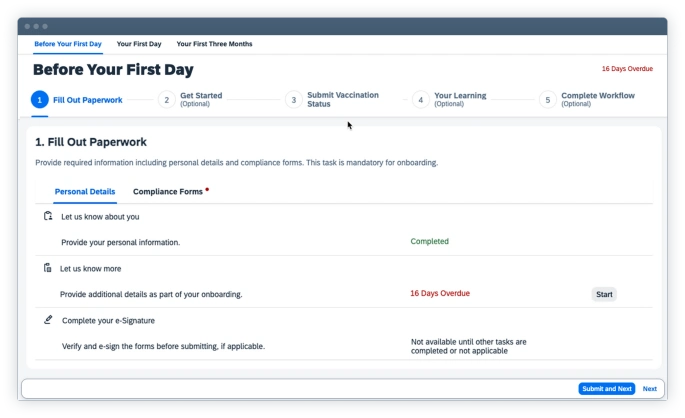
If you want to check whether your onboarding is truly under control, ask one question: can you tell, at any moment, where a new hire is in the 0–180 day journey and what’s blocking them? If the answer is “it depends,” it usually means the company learns about issues only after they’ve already grown. In SAP SuccessFactors Onboarding, that question becomes a progress view (tasks, statuses, overdue items) instead of “let’s see who has it.”
To talk about order in onboarding at all, you need order in your data first. A single source of truth about the employee isn’t a “nice-to-have.” It’s the condition for consistent reporting and for accountability not to dissolve across systems and files. See: “Zero data risk: how one source of truth in HR protects the board from decision paralysis".
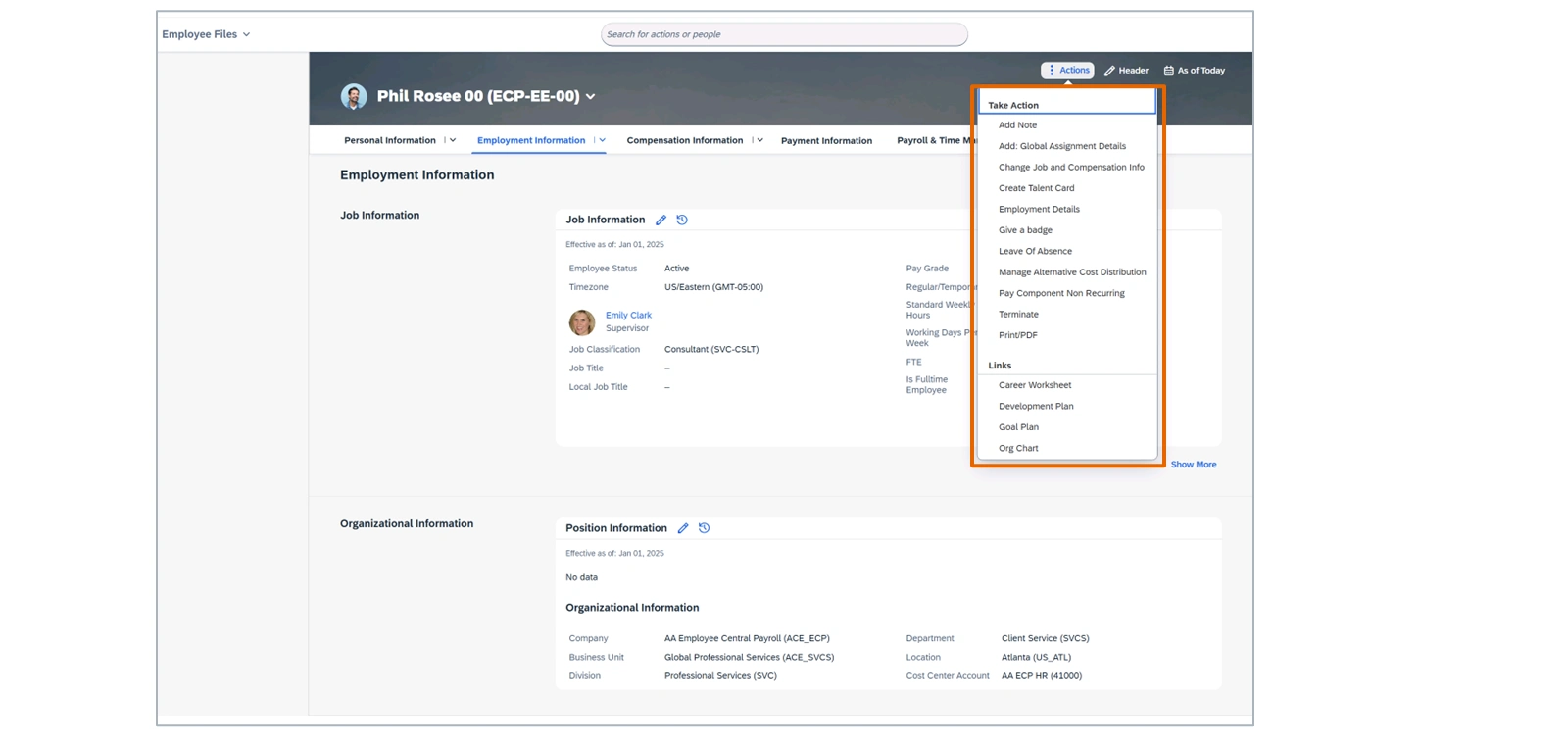
That’s why it’s worth connecting Onboarding with Employee Central: one consistent data set (role, manager, organizational unit) triggers the process in SAP SuccessFactors Onboarding without manual workarounds.
Do CFOs and COOs ask about onboarding?
Leadership teams don’t talk about “onboarding.” They talk about outcomes: projects slipping, people dropping out after a few months, managers running out of bandwidth, and recruiting coming back like a boomerang for the same roles. It’s one puzzle - just viewed through the lens of performance.
Early attrition (0–180) hurts differently than any other attrition
If someone leaves after two years, the company has already captured real value from that person’s work. If someone leaves after three to five months, the company has paid the costs but hasn’t reached the payoff. First come the investments: recruiting, ramp-up, team time, manager time. Only later does it start to pay back. When that payoff never comes, the bill remains - and it shows up in several places at once.
What’s more, early attrition is rarely “random.” It often follows patterns - within one business unit, across a few managers, or within a specific role family. Without data, you won’t spot it in time. You’ll only see the outcome: another hiring cycle for the same position. This is where a hard process helps: who does what, and by when. In SAP SuccessFactors Onboarding, you can set this up as a standard with tasks for HR, the manager, and IT with due dates and status.
Time to productivity: the most expensive thing is what you don’t measure
A new hire needs time. Of course they do. But “time” can be defined and managed.
The simplest move is to define clear autonomy thresholds for role families. What does “delivering” actually mean? Which tasks? What quality? What volume? And so on. Without that, two truths coexist: HR believes onboarding is working because emails were sent and trainings were assigned, while the business believes “nothing works” because the person still isn’t taking load off the team.
Once the threshold is defined, you can measure time-to-threshold. And once you can measure it, you can look for the causes of delays. Very often, delays aren’t about capability. They’re about basic things: no access, unclear expectations, no regular feedback. In SuccessFactors Onboarding, these “basic” issues are easier to catch because you can see what’s overdue (e.g., access, trainings, checkpoints) and escalate it - rather than discovering it after the fact.
Managerial drag: the cost that grows quietly
There’s a cost that almost always gets missed because it doesn’t appear on an invoice: manager time. When onboarding is manual, the manager becomes the process controller - chasing access, tracking documents, explaining systems, building the first work plan, and then correcting early mistakes. It’s not an exception; it’s the norm in companies where onboarding is treated as a “soft topic.” Managers are overloaded because they end up doing work the process should be doing.
That’s why a sensible SAP SuccessFactors Onboarding implementation focuses on taking load off the manager: tasks are assigned, deadlines are visible, and reminders are sent automatically.
Compliance and audit: good intentions don’t pass an audit
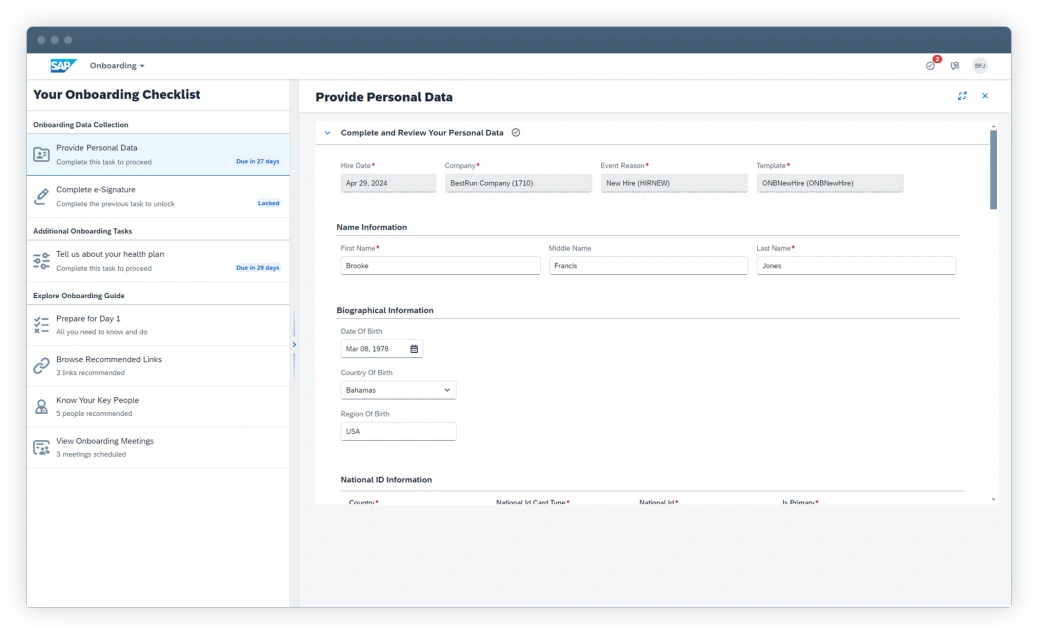
If onboarding includes mandatory trainings, system access, and confirmations, sooner or later someone will ask: who approved this, and when? If the only answer is “let’s check emails,” the company is in firefighting mode, and firefighting is always expensive. That’s why the execution trail matters: SAP SuccessFactors Onboarding can provide evidence that key steps were completed (who/what/when), instead of reconstructing the story from email threads.
The 0–180 ledger: three costs you pay either way
If you want to convince leadership to tighten onboarding, start with the costs:
1. A lost hire in 0–180
Recruiting isn’t just an agency fee. It’s HR time and manager time spent on interviews. Then come start-up costs: equipment, accounts, trainings, admin. Next comes the most painful cost: team time. People interrupt their work to onboard, answer questions, fix issues. And finally there’s delayed productivity: the gap between what the company assumed it would get and what it actually got in the first months.
2. Delayed productivity
First you define the autonomy threshold (by role families, not by every single position). Then you measure time-to-threshold and ask: why does it differ across units and managers? In practice, it’s rarely about “motivation.” It’s usually about a lack of consistent standards and a lack of execution. That’s why the process belongs in a tool: SAP SuccessFactors Onboarding lets you compare units and managers based on completed steps - not declarations.
3. Managerial drag
You can quantify it in minutes. Ask managers how many hours per week onboarding consumes across the first weeks, then add escalations and downtime. In many companies, this is the moment the real scale of the cost becomes obvious.
The same mechanism appears in recruiting: if CV screening is manual and slow, time-to-fill grows and the cost of an empty seat rises. Then pressure shifts to onboarding, because the business wants to “get the person productive quickly.” See: “The cost of an empty seat: how much you lose on manual CV screening - and how to stop it”.
0–180 as a system
For onboarding to stop being a lottery, four elements must work together: standard, ownership, execution, and measurement.
Standard 0-30–60–90→180: what must happen
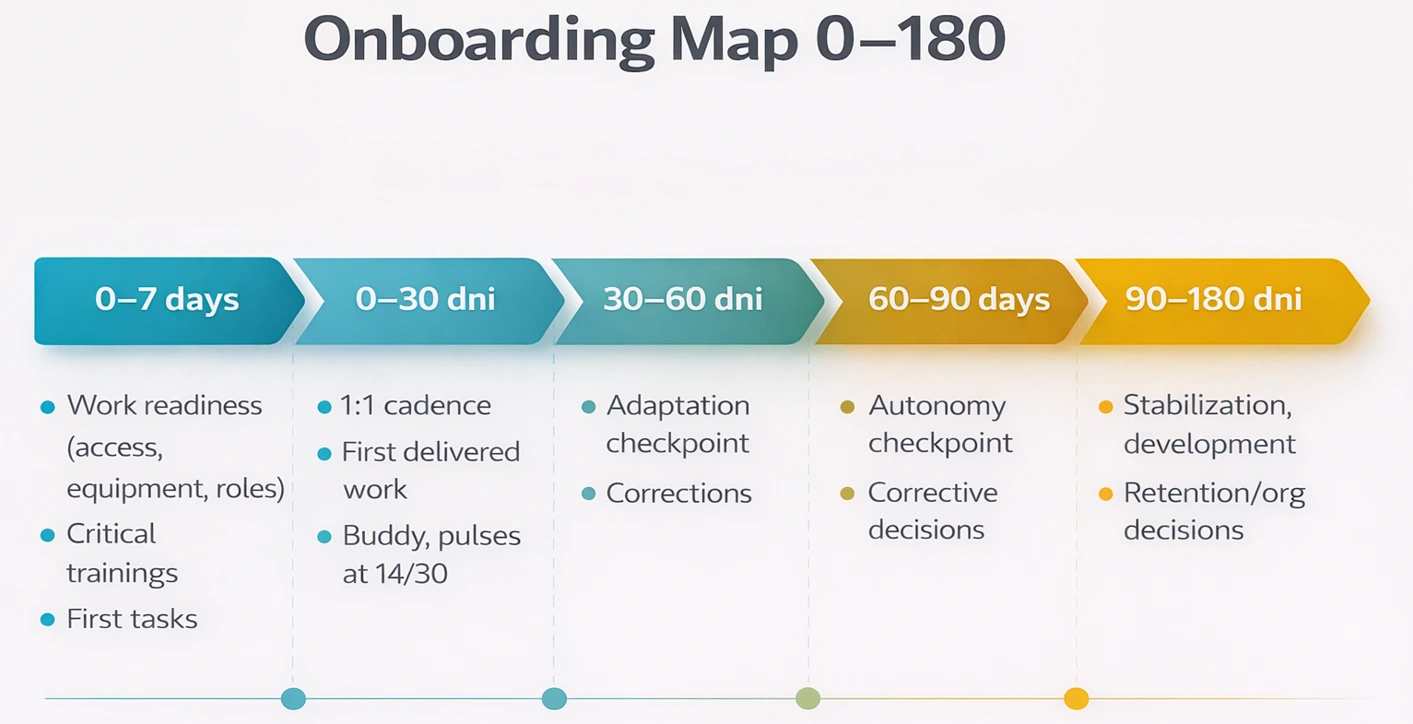
The standard should be simple and verifiable - so you can run it at scale and compare across units. This isn’t an “onboarding program.” It’s the minimum set of steps that protects the company from delays and attrition.
The 0–180 map breaks onboarding into five critical phases that determine whether a new hire gets on track quickly:
- First: close basic work readiness - access, equipment, roles, critical trainings.
- Then: establish a ramp-up cadence - regular 1:1s, buddy support, and short checkpoints.
- Next: make corrections after the first weeks of adaptation, before issues become costly delays.
- Then: verify whether the autonomy threshold is being reached and trigger corrective actions if pace is off.
- Finally: stabilize - development, reinforcing working standards, and retention/organizational decisions.
Ownership: HR, manager, IT, buddy
If everyone is responsible, no one is. In practice, onboarding falls apart on “small” things: access “not ready yet,” 1:1 “got cancelled,” training “I’ll finish later,” buddy “didn’t have time.” That’s not about personalities - it’s about missing role clarity.
HR holds the standard and consistency across units, ensures the process doesn’t end after the first weeks, and watches the data: where do delays repeat?
The manager owns team integration: 30-day goals, first tasks, 1:1 cadence, and feedback. Without that, the rest is cosmetic.
IT/HRIS owns readiness within SLA: access, roles, equipment, accounts. One day late at the start can wipe out the first week.
The buddy helps with day-to-day realities: how the team works, where materials live, who to contact. A buddy accelerates orientation but doesn’t replace the manager.
Execution: where the tool actually matters
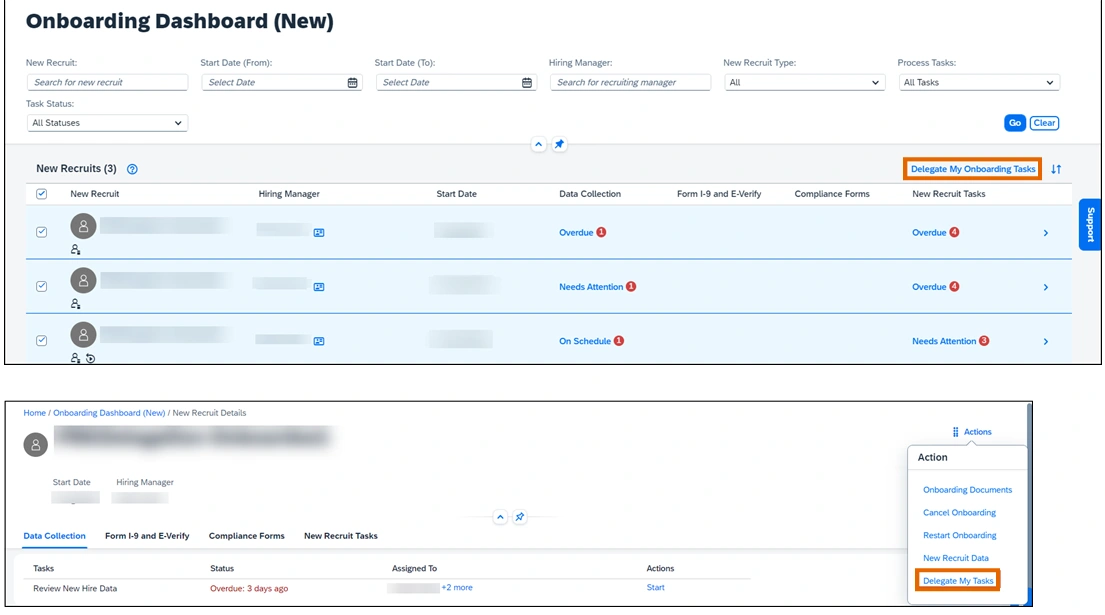
This is the difference between “we have onboarding” and “we run onboarding.” When the process is built on emails and people’s memory, there’s no status, no deadlines, and no single place that shows what’s overdue. A tool matters when it turns the standard into execution. That’s exactly what SAP SuccessFactors Onboarding provides - hard elements missing from manual approaches:
- tasks assigned by role (HR/manager/IT/buddy),
- due dates and completion status,
- reminders and escalation,
- execution trail for critical steps,
- progress reporting per person/unit/manager.
Paired with Employee Central (as the employee system of record), Onboarding stops being a patchwork. It pulls correct data for role, manager, and organizational unit - so you get consistency across sites and meaningful comparisons.
Measurement: KPI that end debates
KPIs should be simple and useful - ones that quickly highlight bottlenecks and decision points. The minimum set:
- 0–180 attrition (with Employee Central as the source for hire/exit data),
- time-to-autonomy threshold (if you define the threshold as a milestone/checkpoint in the process),
- on-time completion of onboarding steps (deadlines, statuses, overdue items),
- IT SLA for work readiness (access/equipment/roles measured via IT tasks in the process),
- pulse checks at 14/30/60/90 (surveys/checkpoints integrated with onboarding),
- overdue items and escalation: how many tasks are past due and how long they remain open (by person, unit, and manager).
“Without vs With”: the visible difference
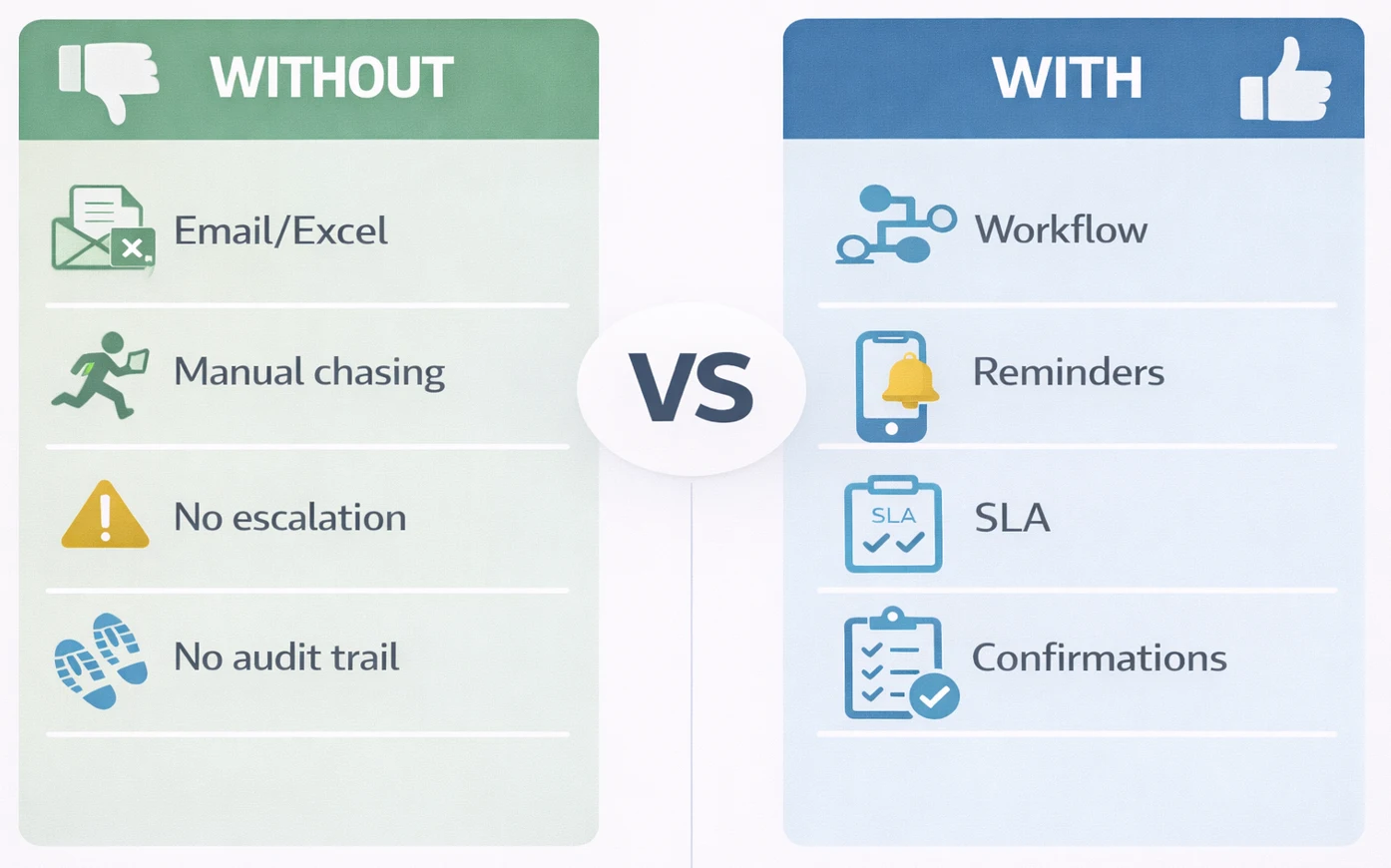
In the “without” version, onboarding relies on memory and goodwill. One manager pulls it off; another doesn’t. One unit runs smoothly; another is chaos. Status is unclear, so people ask around, and still find out too late.
In the “with” version, onboarding has tasks, deadlines, and status. You can see what’s late, where the bottleneck is, and intervene before a new hire concludes “nothing works here.” That’s the shift a well-implemented SAP SuccessFactors Onboarding enables: from emails and memory to status and accountability.
Governance: so the process doesn’t die after go-live
In a well-run model, CHRO needs data and a steady cadence. COO and CFO need clear rules: what counts as an issue, who responds, and within what timeframe. The simplest cadence works best:
- monthly: a quick review of 0–180 KPIs and decisions - where the bottlenecks are and what we do about them,
- quarterly: a standard refresh - what works, what doesn’t, which exceptions we allow and under what conditions.
If onboarding runs in SAP SuccessFactors Onboarding, you have progress reporting directly from the process, see overdue items with owner and due date, and know where onboarding is stuck - immediately, in one place.
Checklist for the board and CHRO
Do we have one 0–180 onboarding standard across the organization or does it “depend on the unit and the manager”?
Can we see onboarding status for a specific person in one place: tasks, owners, deadlines, and overdue items?
Do we have working enforcement - reminders, escalation, and accountability across HR/Manager/IT/Buddy without emails and manual status collecting?
Do critical steps (access, mandatory trainings, confirmations) have a who/what/when execution trail for audit purposes?
Do we report 0–180 comparably across units (attrition, time-to-threshold, on-time completion, IT SLA) and revisit it on a regular cadence?
If three answers are “no” or “I don’t know,” onboarding isn’t a process yet - it’s a set of actions that depends on individuals. That’s the right moment to bring order: turn the standard into tasks, deadlines, status, and reporting in one place.
If today you can’t point to data showing who is at which stage and what’s blocking progress, start with a readiness diagnosis for modern HCM and AI: the HCM AI Readiness Scorecard. It’s the fastest way to move from discussion to a concrete plan. Instead of another generic presentation, you get a specific maturity map and a board-ready PDF.
Start the diagnosis: HCM AI Readiness Scorecard

Ludwik Bogdański is a certified expert with more than 15 years of experience in running and implementing SAP systems integration projects, covering both client implementations and cloud projects, including SAP SuccessFactors and SAP Business Technology Platform (BTP). He specializes in the migration and transformation of SAP systems, providing the highest quality and knowledge necessary for the most complex and demanding projects. During his career, he conducted numerous trainings at SAP Training Centers in Poland and Europe, sharing practical knowledge and best practices. He currently works with the Ensis Technology team, supporting companies in the digital transformation of the HR area. Its key specializations are: • Implementation of SAP S/4HANA and SAP SuccessFactors • Project management according to SAP Activate and PRINCE2 methodologies • Integrations of SAP systems
Latest Articles
A good benefits process begins when employees don't have to ask HR what they are entitled to. They can see their own offer, know the deadlines, and understand what happens after they make a selection.
Recurring payroll adjustments are a sign that an organization is catching exceptions in data, decisions, or information flow too late. This article explores how to increase process predictability and reduce manual reconciliations before month-end closing.
Why is the question "who is available tomorrow?" largely a test of an organization's HR data quality, absence visibility, and decision-making agility? This article shows how SAP SuccessFactors helps organize employee data, absences, working time, and analytics so managers can react more quickly to changes in work schedules.