
Can a transparent compensation policy lead to better budget control, fewer tensions, and greater trust?

Conversations about pay become difficult when there is a lack of clear rules, consistent criteria, and a shared decision-making logic. A transparent compensation policy helps improve budget control, reduce tension, and strengthen trust in the process. However, sound principles alone are not enough if the organisation is unable to sustain them in day-to-day practice and base decisions on consistent data and disciplined execution.
In many organisations, conversations about pay remain one of the most sensitive topics. They stir emotions, can be difficult to predict, and quickly extend far beyond pay itself, while the source of tension rarely lies in the numbers alone.
Much more often, the problem begins with the absence of a transparent compensation policy.
Where there are no clear rules, uncertainty takes over. Some decisions become exceptions, others are made under pressure in the moment, and others still depend on an individual manager’s approach. As a result, the budget becomes less predictable, specific decisions become harder to justify, and trust in both HR and managers gradually starts to erode.
That is why this is a management issue, and why more and more CHROs are beginning to think about how to bring order and consistency back to compensation policy.
Transparency is the foundation of budget control

It is difficult to talk about real control over the compensation budget if pay decisions are made according to different logics, even when each manager is acting rationally from their own perspective.
The problem starts when:
- similar roles begin to be treated differently,
- pay increases become a response to pressure rather than the result of agreed rules,
- exceptions begin to multiply.
At a certain point, the budget starts to drift, even though it is hard to identify the exact moment when the organisation lost full control over it.
A transparent compensation policy is, above all, a shared logic for decision-making. And where that shared logic exists, it becomes easier to forecast costs, plan future budgets, and justify specific decisions calmly and consistently, both within the organisation and in conversations with employees.
In practice, this is also a question of whether pay decisions genuinely support the company’s direction or are merely reactions to immediate pressure.
This connects naturally with the article: How do goals ensure the execution of business strategy? In both cases, the point is the same: to translate strategic assumptions into decisions that can be defended operationally.
In that kind of environment, tools such as SAP SuccessFactors Compensation begin to deliver real value because they:
- support budget planning,
- enforce limits,
- highlight deviations,
- help maintain consistency in decision-making across the organisation.
Fewer tensions when people understand where decisions come from
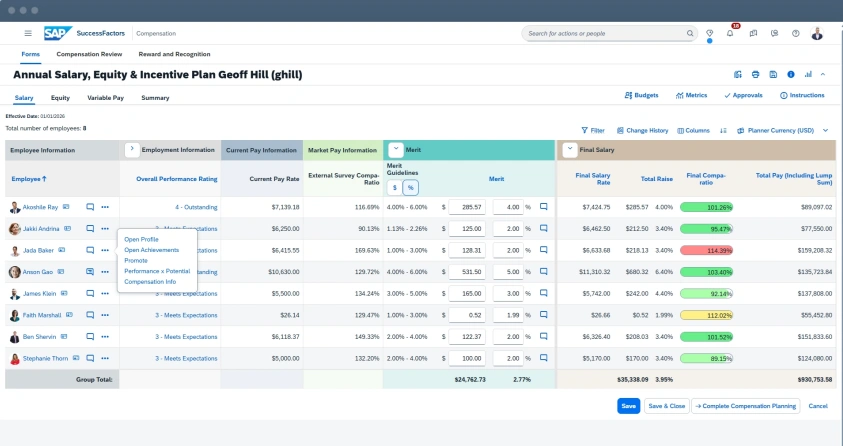
Employees do not need full visibility into every pay data point, but they do need to understand the rationale behind decisions.
Much of the tension around compensation does not come from the fact that someone earns more. It comes from a lack of clarity about why. If, in one department, pay increases are driven by performance, in another by a manager’s ability to argue the case, and in a third by an individual management style, then even fair decisions can start to feel arbitrary or inconsistent.
Transparency does not remove all difficult conversations, but it does bring structure to them. When the rules are clear, the arguments become more consistent, and managers do not have to explain every decision from scratch. That reduces tension and limits room for speculation.
This is also the point at which a very practical question of accountability comes back into focus: who is actually responsible for the quality of these decisions and their consequences across the organisation? See: Half the company is waiting for a decision. Who is meant to make it?
Here too, what matters is not only the policy itself, but how it is applied. SAP SuccessFactors Compensation can support managers by giving them data, context, and clear decision-making frameworks. As a result, conversations about pay become less improvised and more firmly grounded in facts and agreed rules.
Greater trust when rules are applied consistently
Trust does not grow in direct proportion to the size of a pay increase. It grows when people can see that the process is predictable and decisions are not random.
If employees can see that pay decisions are based on the same criteria, follow consistent rules, and rest on stable assumptions, it becomes easier for them to trust not only the process itself, but also managers and the organisation as a whole.
That has very concrete consequences. Trust strengthens managers’ credibility, reduces the risk of unnecessary tension, and helps build the image of the company as a well-organised, predictable place to work. Over the longer term, it also affects retention and the quality of internal relationships.
There is one condition, however: rules alone are not enough. They must also be applied consistently. And this is exactly where many organisations encounter their biggest challenge, because day-to-day practice can blur even the best-designed policy.
What use is a sound policy if day-to-day reality blurs everything anyway?
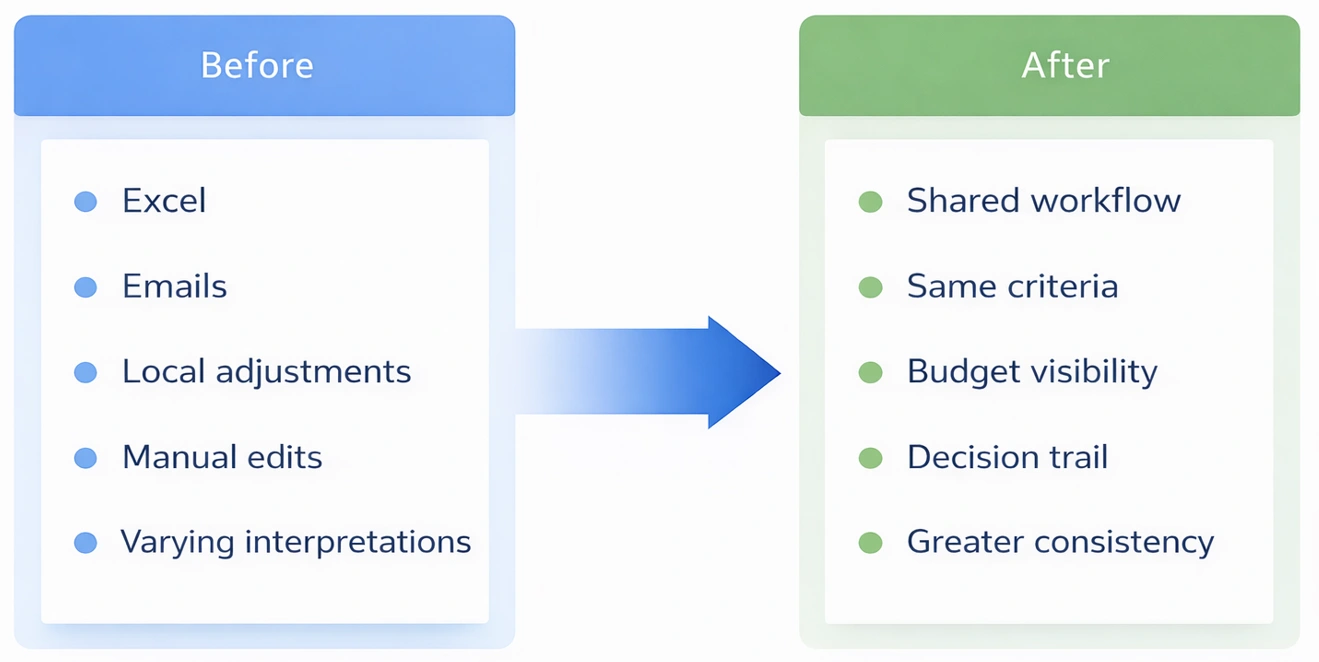
Even the best compensation policy can quickly lose coherence when it collides with day-to-day reality: Excel sheets, emails, local arrangements, time pressure, and different interpretations on the part of managers.
At the level of assumptions, everything may look fine. In practice, exceptions return, local rules emerge, and decisions are made more intuitively than systematically. That is why transparency requires not only rules, but also a way of enforcing them consistently.
This leads to another important issue: data quality and information consistency. It is difficult to talk about pay transparency if different people are working from different versions of the data, different reports, and different reference points. Read: Zero data risk: How does a single source of truth protect against management paralysis?
Policy alone is not enough - you also need to be able to sustain it in practice
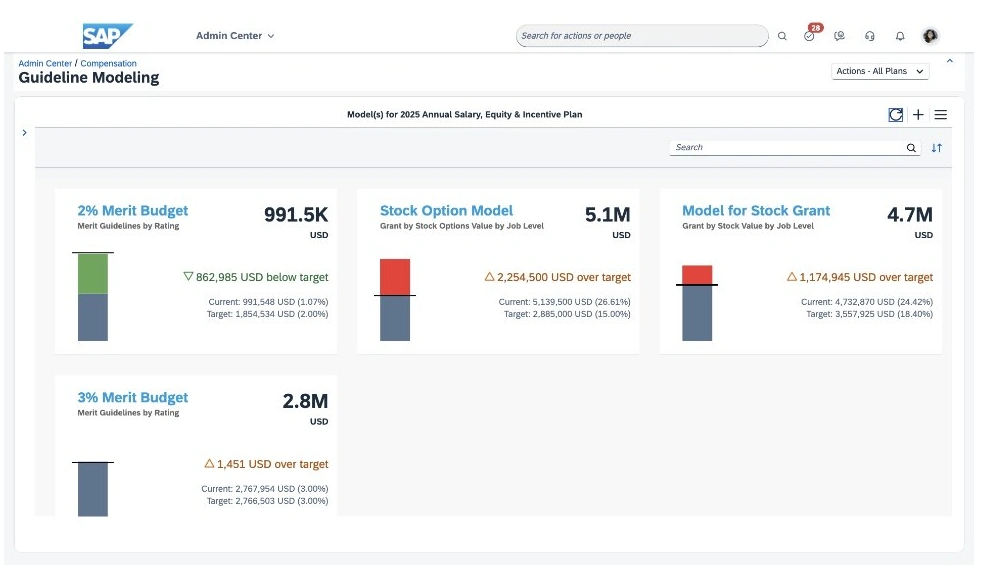
Not as a first step. Not as a universal remedy. And not as just another HR platform that has to be “implemented because that’s what companies do.”
The role of the system emerges when the organisation already has a structured compensation logic in place and wants to ensure that it works not only at the level of policy or principles, but also in day-to-day decisions.
That is when SAP SuccessFactors Compensation begins to make real sense. It helps translate agreed rules into practice:
- supports budget control,
- structures the decision-making process,
- increases visibility of changes,
- reduces the risk of local, inconsistent decisions.
In practice, this means it becomes easier to control the budget within previously agreed parameters, maintain consistency across managers, and support them in conversations with employees. It also brings greater order to the process itself and reduces the amount of manual intervention that still consumes too much time in many organisations.
Most importantly, technology does not replace policy. It helps sustain it.
Summary
A well-structured compensation policy gives the organisation three important benefits:
- better budget control,
- fewer tensions,
- greater employee trust.
This is because it introduces a shared decision-making logic, brings order to the way the organisation thinks about pay, and reduces discretion where exceptions and pressure once dominated.
SAP SuccessFactors Compensation, in turn, can be a natural support for this approach as a tool that helps maintain agreed rules in day-to-day practice, regardless of the size of the organisation, management style, or number of decisions being made.
Ultimately, transparency is not a document, but a way of managing. And if an organisation wants that way of managing to work in practice, it needs not only sound principles, but also tools that help preserve consistency.
If you want to assess the maturity of your key HR processes and identify what needs to be put in order in your organisation, complete the HCM AI Readiness Scorecard. At the end, you will receive a 6–12 month roadmap and a PDF for the Board.

Ludwik Bogdański is a certified expert with more than 15 years of experience in running and implementing SAP systems integration projects, covering both client implementations and cloud projects, including SAP SuccessFactors and SAP Business Technology Platform (BTP). He specializes in the migration and transformation of SAP systems, providing the highest quality and knowledge necessary for the most complex and demanding projects. During his career, he conducted numerous trainings at SAP Training Centers in Poland and Europe, sharing practical knowledge and best practices. He currently works with the Ensis Technology team, supporting companies in the digital transformation of the HR area. Its key specializations are: • Implementation of SAP S/4HANA and SAP SuccessFactors • Project management according to SAP Activate and PRINCE2 methodologies • Integrations of SAP systems
Latest Articles
A good benefits process begins when employees don't have to ask HR what they are entitled to. They can see their own offer, know the deadlines, and understand what happens after they make a selection.
Recurring payroll adjustments are a sign that an organization is catching exceptions in data, decisions, or information flow too late. This article explores how to increase process predictability and reduce manual reconciliations before month-end closing.
Why is the question "who is available tomorrow?" largely a test of an organization's HR data quality, absence visibility, and decision-making agility? This article shows how SAP SuccessFactors helps organize employee data, absences, working time, and analytics so managers can react more quickly to changes in work schedules.