
Where do benefit problems begin? When an employee cannot see what they are entitled to and when they can make a selection

Employees should be able to check their own benefits, see how long they have to make a choice, and understand what happens after they enroll. For this to work, the system must use up-to-date employee data, accurate eligibility rules, and clearly defined deadlines. If these elements are scattered or require manual interpretation, questions will keep coming back to HR, and the process will depend on the knowledge of specific individuals. SAP SuccessFactors Employee Central Global Benefits helps integrate data, rules, and employee choices into a single, cohesive process that boosts self-service and reduces the need for manual explanations of standard issues.
A benefits catalog can be comprehensive, yet employees may still not know which benefits apply to their specific situation. A list alone does not answer questions about eligibility, enrollment deadlines, or when a change will take effect.
The answer depends on employee data, organizational rules, and previous selections. If this information is stored in different places or updated at different times, employees cannot verify their own status.
That is when the question goes to HR. One inquiry is easy to resolve. However, if similar questions arise during every enrollment period, it is worth examining where the answers come from, who maintains the rules, and when changes should be reflected in eligibility determinations.
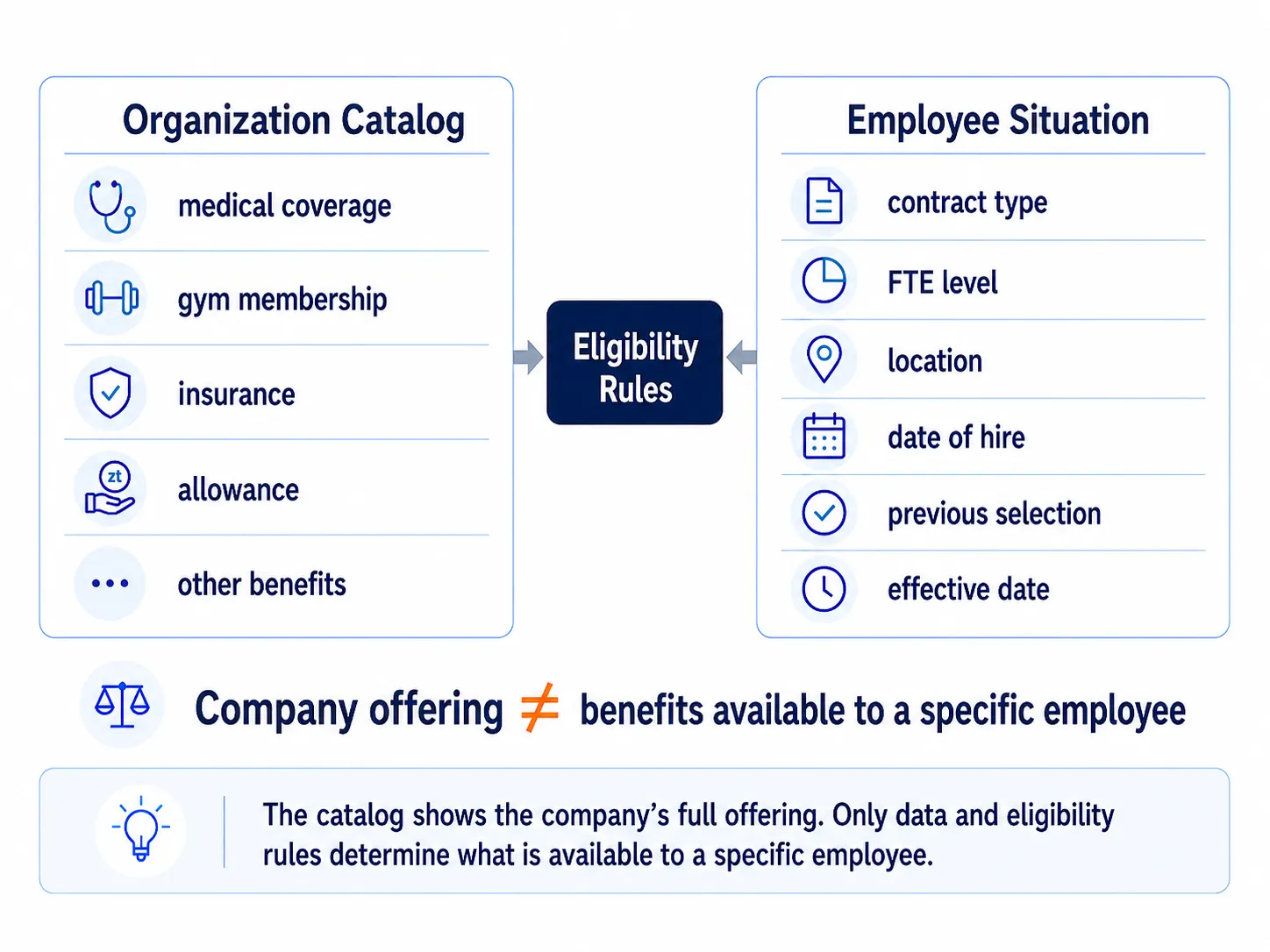
The catalog shows the offer, not the individual employee's situation
Benefit eligibility can be determined by contract type, full-time equivalent (FTE), location, organizational unit, hire date, or previous selections.
Therefore, the answer to the question "Am I eligible for this benefit?" depends on several data points and rules.
The number of rules itself is not necessarily a problem. The difficulty arises when data is maintained in different places, changes at different times, or lacks a clear owner. In such cases, HR must reconstruct the employee's situation: check personnel records, compare them against the policy, find previous selections, and determine if the deadline still allows for a change.
If different teams or systems use different versions of the same data, the problem arises even before eligibility is checked. Read more about the consequences of inconsistent information in our article: Zero data risk: how a single source of truth protects against management paralysis?
Selecting a benefit does not end the process
An employee may find the right benefit and make a selection. From their perspective, the matter may not be resolved yet.
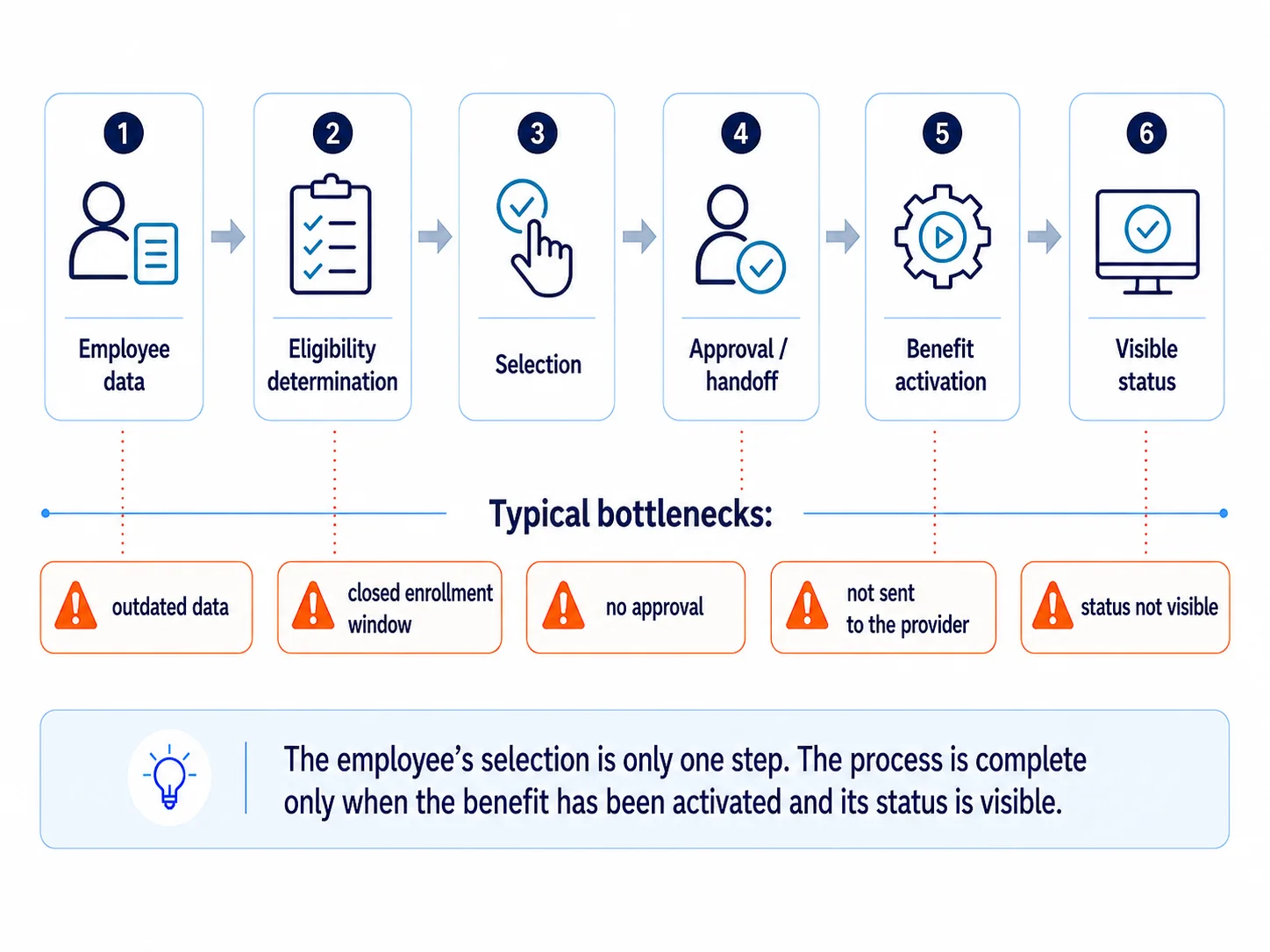
First, data and rules determine eligibility. Then, the employee selects a benefit. The selection may still require verification, approval, or submission to a provider. Only at the very end is the benefit activated. Each of these stages may work correctly on its own. The problem arises when the entire journey is not visible.
An employee has selected an extended medical package. However, they do not know if the request has been accepted, if an additional decision is needed, or from which month the change will take effect. The form has been submitted. The information has been saved.
The answers are still missing.
A correctly saved selection does not always mean that the benefit has been activated and is visible to the employee.
When employees cannot see the process, HR has to reconstruct it
If an employee cannot see their eligibility, deadlines, or selection status, they contact HR. The response must then be compiled from several sources: the policy, HR records, previous selection history, and information received from the benefits provider.
Manual handling leads to follow-up messages, coordination between teams, and checking whether information has already been passed on. The process starts to depend on the knowledge of specific individuals. The workload is just one of the consequences.
With a higher volume of requests, it is harder to ensure that people in similar situations receive the same answer. One person might interpret an enrollment deadline differently. Another might fail to account for a recent change in an employee's data. After a few weeks, it is difficult to reconstruct the basis for a decision. The process becomes less predictable. It also becomes harder for the organization to verify whether the same rules are being applied consistently.
The less information an employee can check on their own, the more time HR spends retracing the steps of standard inquiries.
A similar mechanism appears in other self-service processes. A form may be available, but the employee still does not know if it applies to their situation, who will handle the request, or what will happen after it is submitted. I expand on this topic in the article: How to transition form chaos to simple HR self-service?
Start with the rules and the process owner
Moving a process into a system will not solve the problem if the rules have not been established beforehand.
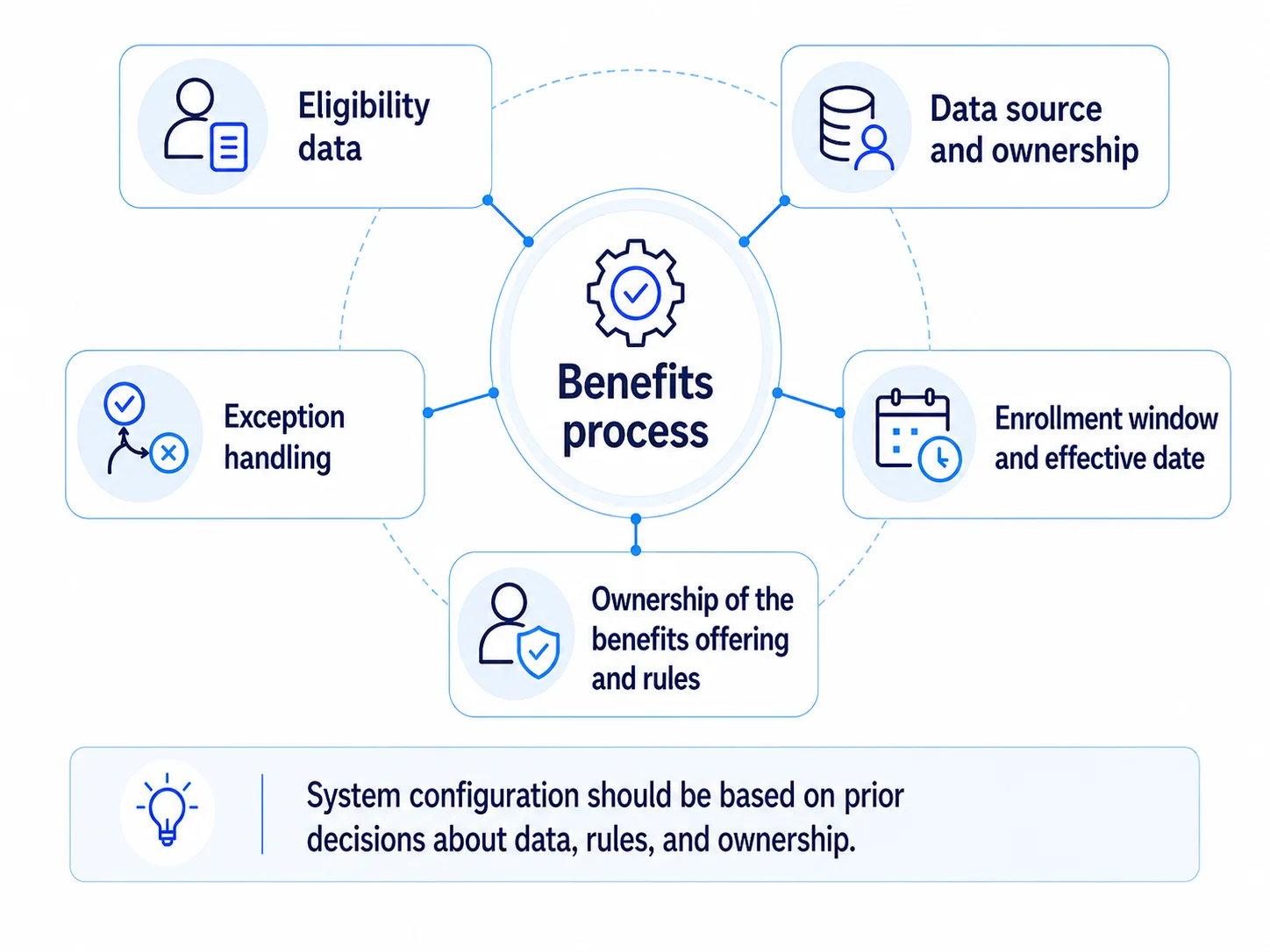
It is worth answering five questions:
- What data determines an employee's eligibility?
- Where is the source of this data, and who is responsible for its accuracy?
- When can an employee make a selection, and when does the change take effect?
- Who is responsible for keeping the offer and the rules up to date?
- Who makes the decision in the event of an exception?
The policy may be well-written and the benefits offer published. The process will still stall if it is unclear who updates the information and who resolves cases that fall outside the standard rule. The timing of the change also matters.
New hires, changes in FTE, transfers to different units, or life events can affect an employee's eligibility. You must determine not only which rule applies but also when the new situation should be taken into account.
Without this, an employee might see information that is correct according to previous data but inconsistent with their current situation. Technology can display available benefits. It will not determine for the organization who is responsible for the data, rules, and handling of exceptions.
What technology can organize
Only after the rules have been established can you meaningfully proceed to configuring the solution.
SAP SuccessFactors Employee Central Global Benefits can support a process where employee data, eligibility rules, and enrollment periods determine which benefits an employee can see and select.
From the employee's perspective, the result should be simple. They see benefits relevant to their situation. They know the deadline. They make their choices and can review them later.
From the HR perspective, visibility into rules, employee choices, and exceptions is key. Standard questions shouldn't have to go to a person who has to piece together an answer from multiple sources every time.
However, the system will not replace accurate data, clear rules, or a process owner. If the rules are unclear, technology will simply move that ambiguity to another channel.
Where to start
It is worth revisiting questions from the last enrollment period to check what employees couldn't determine on their own, how many sources HR had to pull answers from, and which cases required manual decisions.
Such a review will show where the process stalls: in communication, data, eligibility rules, status visibility, or accountability for a specific stage.
Can an employee currently check on their own what they are entitled to, when they can make a selection, and what happens after they do?
If a similar pattern repeats in other HR processes, HCM AI Readiness Scorecard helps identify which areas of data, accountability, and ways of working need to be organized.

Ludwik Bogdański is a certified expert with more than 15 years of experience in running and implementing SAP systems integration projects, covering both client implementations and cloud projects, including SAP SuccessFactors and SAP Business Technology Platform (BTP). He specializes in the migration and transformation of SAP systems, providing the highest quality and knowledge necessary for the most complex and demanding projects. During his career, he conducted numerous trainings at SAP Training Centers in Poland and Europe, sharing practical knowledge and best practices. He currently works with the Ensis Technology team, supporting companies in the digital transformation of the HR area. Its key specializations are: • Implementation of SAP S/4HANA and SAP SuccessFactors • Project management according to SAP Activate and PRINCE2 methodologies • Integrations of SAP systems
Latest Articles
Recurring payroll adjustments are a sign that an organization is catching exceptions in data, decisions, or information flow too late. This article explores how to increase process predictability and reduce manual reconciliations before month-end closing.
Why is the question "who is available tomorrow?" largely a test of an organization's HR data quality, absence visibility, and decision-making agility? This article shows how SAP SuccessFactors helps organize employee data, absences, working time, and analytics so managers can react more quickly to changes in work schedules.
A competency map helps verify if an organization has the people needed to execute its strategy, new projects, and business changes. Organized competency data supports CHRO and board decisions regarding development, succession, reskilling, and recruitment.