

Competency data scattered across HR systems, training histories, spreadsheets, performance reviews, and managers' knowledge makes it difficult to quickly make decisions about development, succession, reskilling, and recruitment. A competency map helps CHROs and the board more quickly identify gaps, potential, succession risks, and areas requiring development, internal mobility, or recruitment. This approach supports more informed business decisions.
Imagine a situation where the board decides to launch a new project, enter a new business area, or accelerate digital transformation. At the strategic level, everything looks good: there's a goal, budget, timeline, and expected business outcome. However, at some point, a question arises that can halt the entire plan:
Do we have people with the right competencies within the organization to achieve this?
In many companies, the answer isn't obvious. Employee competency data exists, but it's scattered. Some is in HR systems, some in training histories, some in performance reviews, some in spreadsheets, and some in managers' heads. As a result, the organization knows it has many talented individuals, but it can't always quickly pinpoint exactly where they are, what skills they possess, and how they can be utilized.
This problem can be called the map of lost competencies. It's an apt metaphor for a situation many organizations are familiar with: competencies exist within the company, but it's difficult to see them in a single, organized view.
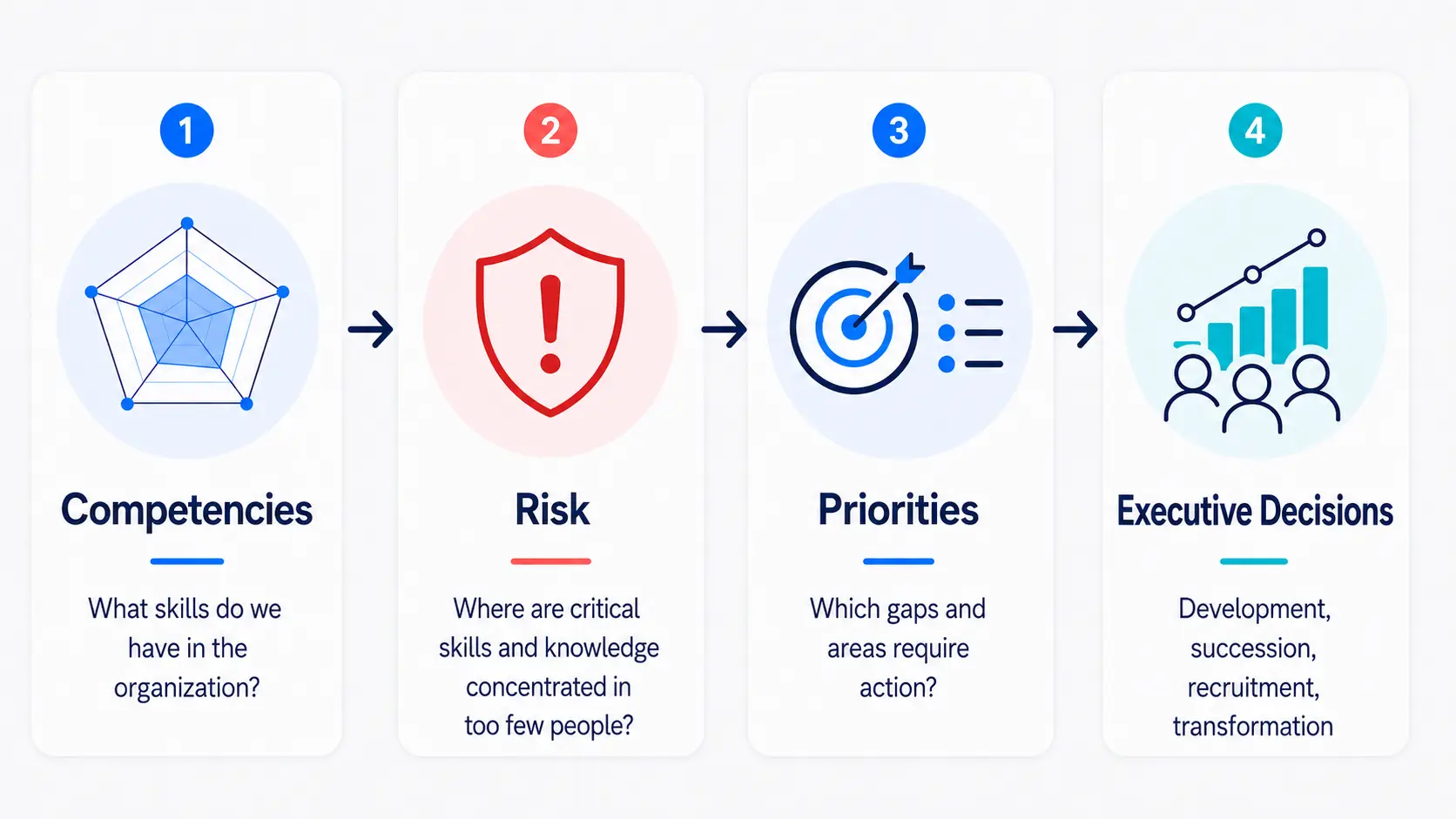
For CHROs and the board, a competency map is a way to make better decisions regarding people development, succession, reskilling, recruitment, workforce planning, and mitigating competency risk.
Competencies exist within the organization, but they are often hard to see.
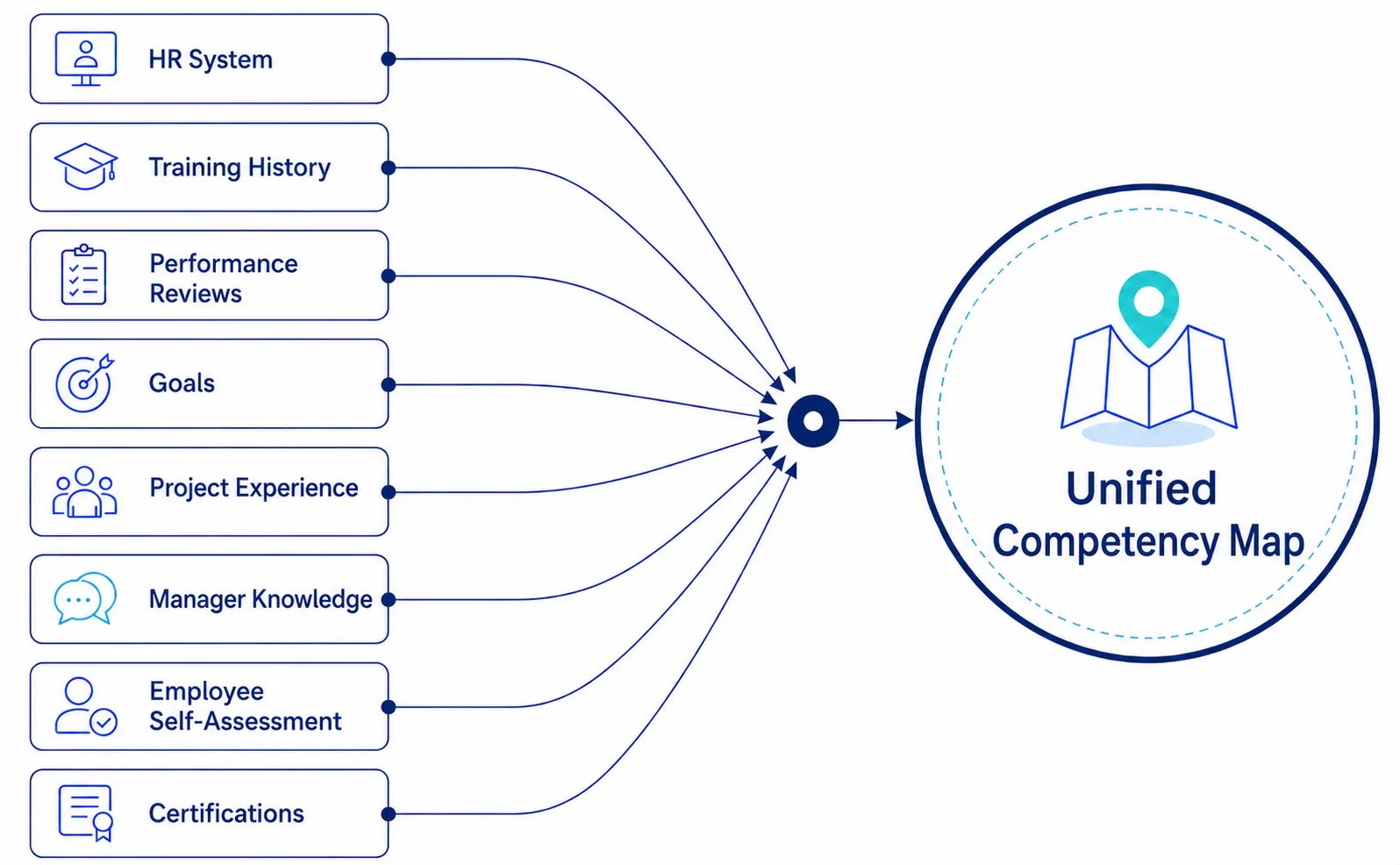
The problem for many companies isn't a complete lack of competency information. HR might have access to training and certification data. Managers know who performs well in specific projects. Employees have experiences that aren't always visible in their current role. Systems may contain job descriptions, goals, performance reviews, or development histories. However, without a common structure, it's difficult to build a complete picture of the organization from this data.
In practice, CHROs and the board often need to answer very specific questions:
- what competencies do we currently have in the organization,
- where are the biggest gaps,
- which teams require reskilling,
- who can be moved to a new project,
- where will external recruitment be necessary,
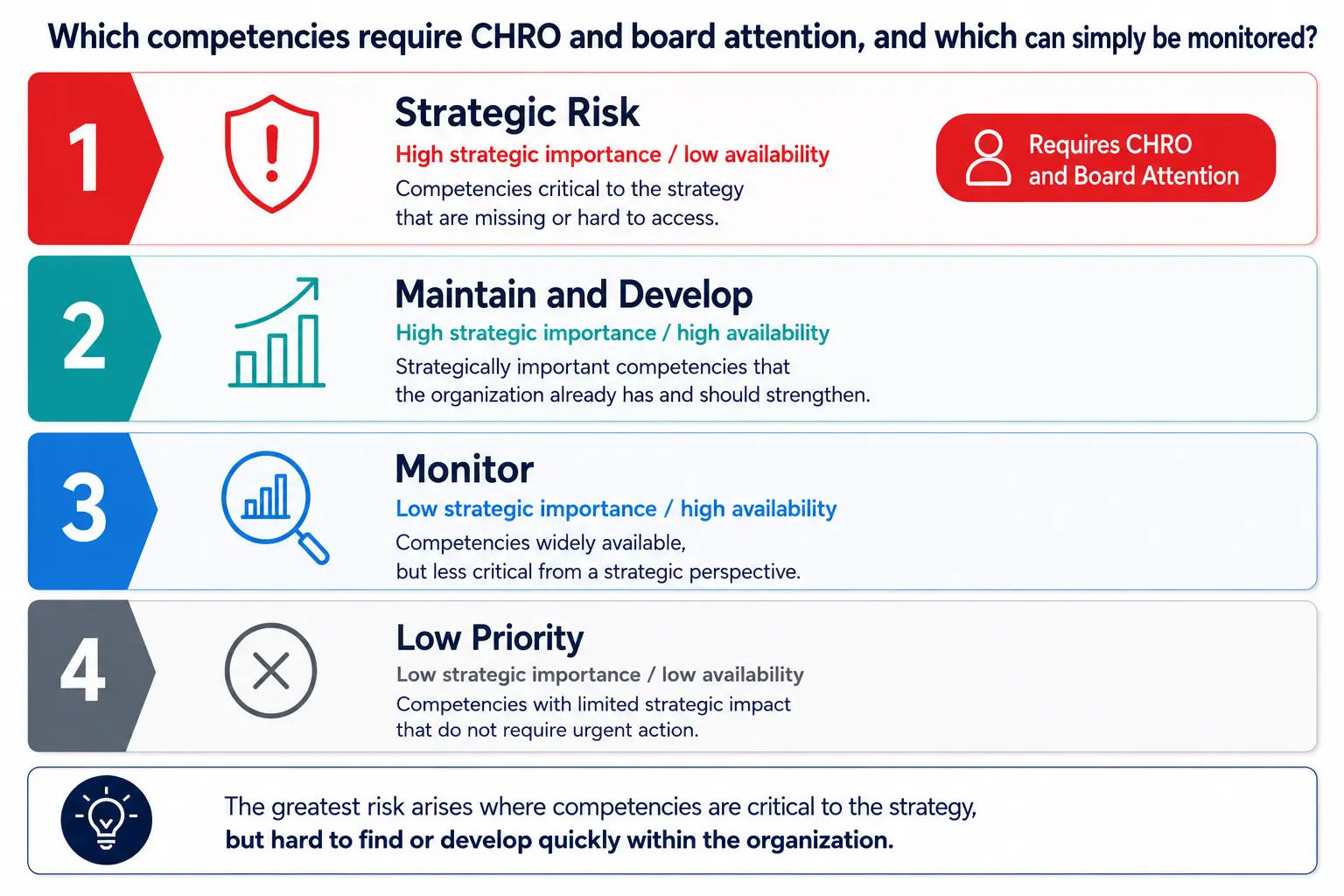
- which competencies are critical for strategy execution,
- where succession risk exists.
If answering these questions requires manually collecting data from multiple sources, speaking with numerous managers, and comparing spreadsheets, the organization loses time and decision-making confidence.
This is the same problem that arises more broadly in HR data management – without a single source of truth, it's difficult to make decisions quickly and with confidence in the data. We wrote more about this in the article: Zero data risk: How does “one source of truth” protect against management paralysis?
Why a lack of a competency map becomes a business risk
A company's strategy is not implemented solely through organizational structure, budget, and financial goals. It is executed by people who possess specific competencies, experience, and potential.
If an organization plans a digital transformation, process automation, expansion, implementation of new technologies, or a change in its operating model, it must know if it has the competencies needed to carry out this change.
Without a competency map, management only sees part of the picture. A company might invest in recruitment even though some of the necessary skills already exist within the organization. It might also assume that a certain area is secure, despite key knowledge being concentrated in just a few individuals. Finally, it might realize too late that it lacks the competencies needed to achieve new business priorities.
From a CHRO's perspective, a competency map allows translating the topic of people into the language of risk, costs, and strategic decisions. As a result, discussions about employee development cease to be general and start addressing specific questions: where to invest, what to develop, whom to prepare for new roles, and which gaps might slow down the business.
What decisions does a competency map support?
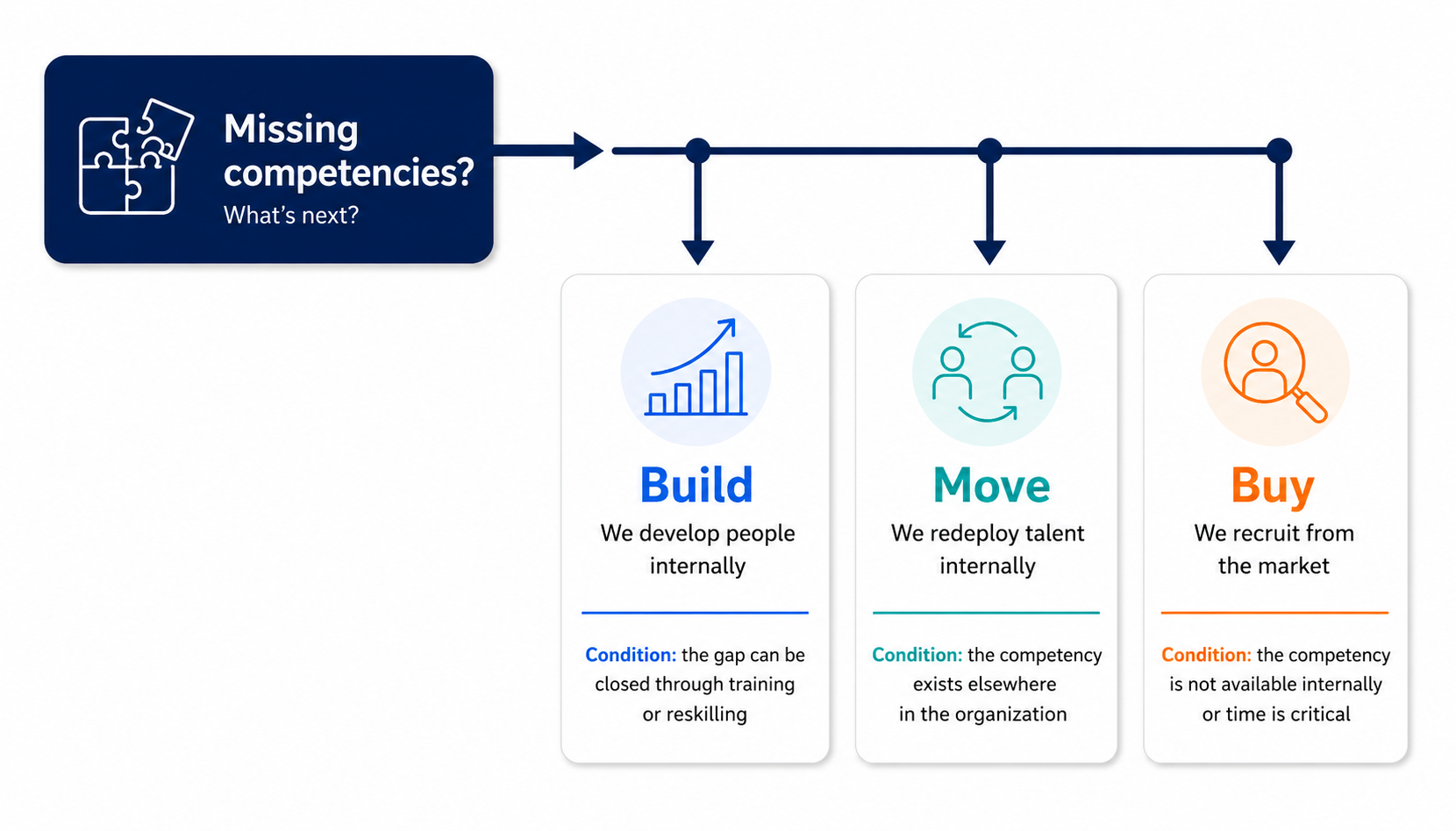
A well-prepared competency map doesn't end with diagnosis. Its value emerges when it helps transition to concrete decisions: which competencies to develop, where to move talent, when to initiate recruitment, and which gaps might impact strategy execution.
Employee development decisions
HR and managers can better determine which competencies are worth developing first. Training budgets can be directed where development has the greatest strategic importance, rather than where needs are most loudly communicated. It also becomes easier to tailor development programs to specific employee groups, roles, and career paths.
Reskilling and upskilling decisions
When an organization changes its operating model, some competencies lose relevance, while others become crucial. A structured overview of competencies allows identifying which teams can be prepared for new tasks, where reskilling is needed, and which individuals have the potential for a role change.
This is particularly important for organizations that want to develop competencies internally instead of filling every gap with external recruitment.
When is it more cost-effective to develop people, and when is it necessary to hire new specialists? We elaborate on this topic in the article: When does LMS-based reskilling outperform hiring, and how do you know?
Recruitment decisions
Recruitment is costly and time-consuming, so it's worth checking beforehand whether the necessary competencies truly need to be sourced externally. Some skills might already exist within the organization, just not be visible in current roles or structures.
This makes recruitment more precise. The company knows what competencies it's looking for, which roles they are crucial for, and how they complement existing resources. A lack of such knowledge often leads to automatically initiating external recruitment, which generates additional costs, extends the time to fill a role, and increases the burden on the HR team.
We wrote more about the costs of this approach in the article: The cost of an empty desk: How much you lose on manual CV screening, and how to stop it?
Succession Decisions
In succession planning, it's important not only to know who holds a key role today, but also who can take on greater responsibility in the future. A competency map helps to quickly identify where the organization has potential successors and where there's a gap.
It also allows for assessing the risk associated with knowledge concentration. If key competencies are concentrated in a few individuals, the CHRO and management can proactively plan for successor development, knowledge transfer, or changes in work organization.
This risk should be analyzed alongside data on retention, engagement, and likelihood of departure. More on this in the article: How to identify turnover risk early with HR analytics?
Project and Operational Decisions
In many companies, new projects require quickly building a team with specific competencies. Instead of relying solely on networks and manager recommendations, an organization can more quickly identify who has the necessary experience, who can support the project, and where the team needs to be supplemented. This facilitates internal mobility and better utilization of talent. Strategic Decisions
The greatest value of a competency map emerges when it supports discussions about the organization's future. Management can see if the company has the competencies needed to execute its strategy, which areas require investment, and where a lack of people with specific skills could become a barrier to growth.
A competency map should not operate in isolation from business objectives. If an organization knows what goals it wants to achieve, it's easier to determine which competencies will be truly critical and which are of lesser strategic importance.
In this context, it's also worth reading the article: How do goals ensure the execution of business strategy?
The Role of CHROs, HR Business Partners, and Managers
CHROs are increasingly responsible for more than just efficient HR processes. Their role is to demonstrate how people, competencies, and organizational structure impact strategy execution.
A competency map aids in this conversation by providing a concrete picture of potential and risk. Instead of generally stating that the organization needs digital competency development, the CHRO can pinpoint which teams have the largest gaps, which groups require support, and where management decisions are needed.
This changes the position of HR. Competency data ceases to be an internal HR department resource and becomes an element of organizational management.
A competency map also holds significant value in the daily work of HR Business Partners and managers.
HR Business Partners can conduct discussions with leaders based on data, rather than just general observations. They can identify gaps, propose development initiatives, plan succession, and connect business needs with HR actions.
Managers gain a better understanding of their teams. They can see which competencies are strengths, where gaps exist, and who might be ready for new challenges. This facilitates task delegation, development planning, and employee discussions.
It is important, however, that a competency map is not a static report prepared once every few years. Its value increases when it is updated and utilized in real decision-making.
Where does technology fit into this?
Building a competency map can start with a simple model and basic diagnosis. In larger organizations, however, the question quickly arises: how to keep data in an up-to-date, consistent, and useful form?
A spreadsheet can be a good start, but over time it becomes a limitation. Competencies change dynamically. Employees complete training, gain project experience, change roles, and develop new skills. Managers update job expectations, and organizational strategy shifts its focus to new areas.
This is why technology matters. An HCM system can help connect competency data with other HR processes: development, training, goals, performance reviews, internal mobility, or talent planning.
In this context, it's worth looking at SAP SuccessFactors and Talent Intelligence Hub. Not necessarily as a "magic solution" for all HR problems, but rather as an example of an approach that helps organize data on employee competencies, skills, and attributes in a more consistent way.
Technology has value when it supports a well-thought-out competency management strategy. The system does not replace the decisions of the CHRO, board, and managers. However, it can provide them with better data, a more current picture of the organization, and greater consistency in HR activities.
SAP SuccessFactors and Talent Intelligence Hub as support for a structured approach
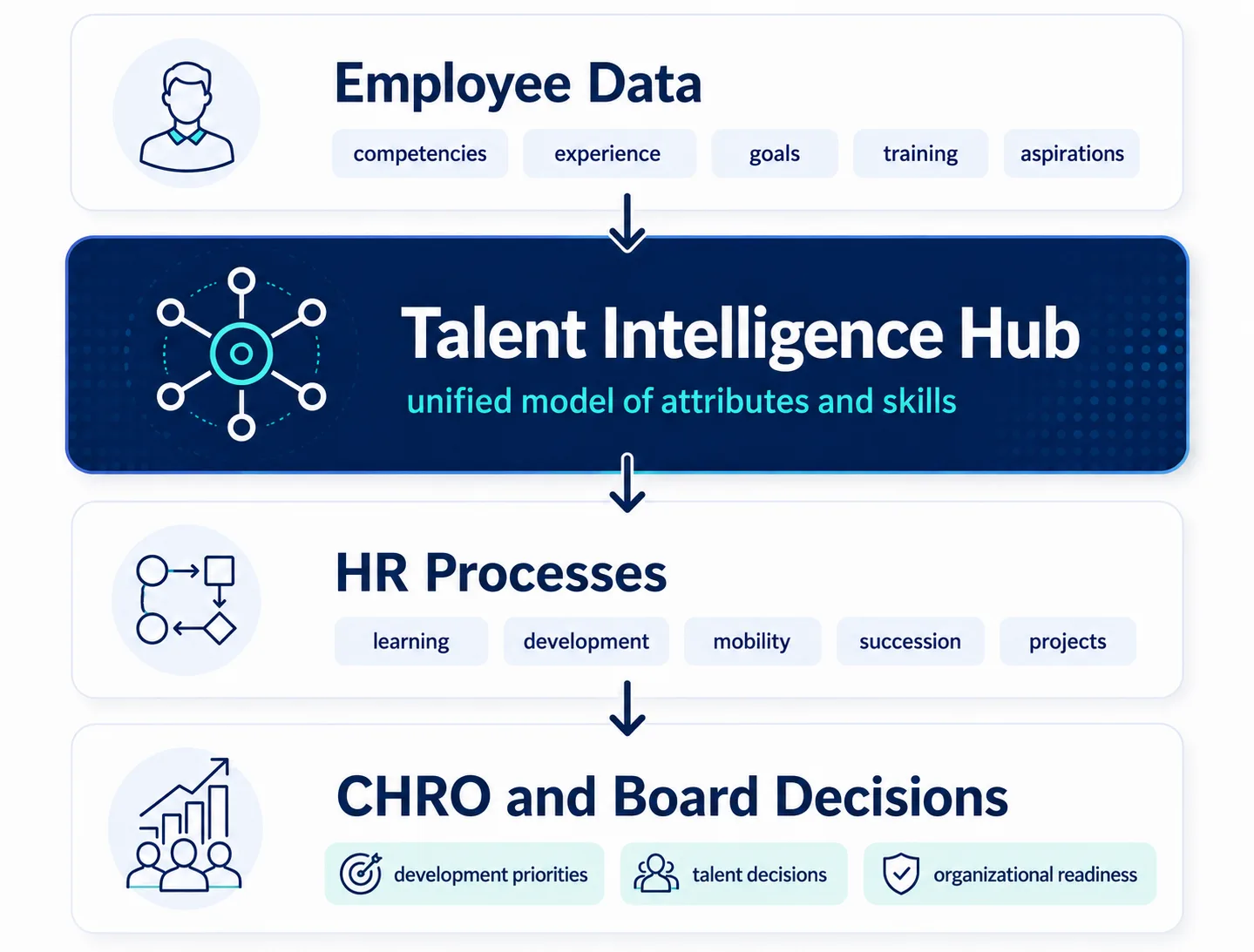
SAP SuccessFactors can support organizations in more systematic management of HR and talent processes. In the context of a competency map, it is particularly important that data on employees, roles, development, and experience can be utilized in a broader talent management process.
Talent Intelligence Hub should be seen as an element that helps build a more consistent picture of competencies and skills within an organization. This makes it easier to connect information about people with development, training, mobility, career planning, and managerial decisions.
For CHROs, what matters is not just having data in the system, but the ability to use it in practice. If the data helps identify gaps, plan development, prepare for succession, or better match people to projects, it becomes real decision-making support.
Where to start building a competency map?
The first step should not be to create a very extensive catalog of all possible competencies. It's better to start by asking: which competencies are truly important for the organization's strategy?
Next, it's worth organizing roles and expectations. It is necessary to determine what competencies are needed in key areas of the company, which roles are critical, and what skills will be important in the future.
The next step is to collect data on the current level of competencies. Various sources can be used: information from HR systems, training history, certificates, project experience, managerial assessment, employee self-assessment, or data from development processes.
Only then can one proceed to identify gaps and risks. It is worth checking where competencies are lacking, where knowledge is concentrated in too small a group of people, which teams require reskilling, and where recruitment decisions are needed.
The most important thing, however, is that the competency map is linked to decisions. The map itself does not create value if no one uses it. Value emerges when it supports discussions about development, succession, projects, recruitment, and strategy.
Competency map and employee experience
.webp)
A competency map should not be just another form that an employee has to fill out occasionally, only to never see the results of their effort. If competency updates rely solely on surveys, manual submissions, and scattered forms, it quickly becomes another administrative burden.
Therefore, it's worth considering a competency map also in the context of simple HR self-service. Employees should be able to easily update information about their skills, experiences, and development aspirations. In SAP SuccessFactors, Growth Portfolio is an example of this approach, providing employees with a more organized view of their competencies, attributes, and proficiency levels. If such a profile is updated regularly, competency data ceases to be merely an HR resource and begins to genuinely support employee development, manager decisions, and broader organizational analysis. Managers should have easy access to team data. HR should see a broader picture of the organization without the need for manual data collection from multiple sources.
This approach aligns well with the topic of employee self-service, which we described in the article: How to transition form chaos to simple HR self-service?
Common mistakes when creating a competency map
One common mistake is creating an overly complicated competency model. If the model is too detailed, difficult to maintain, and unclear to managers, it quickly loses its practical value.
A second mistake is the lack of alignment between competencies and strategy. A competency map should answer specific business questions, not be a catalog of everything the organization might want to know about its employees.
A third problem is treating the map as a one-off project. Competencies evolve with the organization, so the map requires regular updates and a process owner.
A fourth mistake is relying solely on self-assessment or solely on a manager's opinion. A better picture emerges when the organization combines various data sources and clearly defines how to interpret competency information.
A fifth mistake is moving too quickly to technology without first clarifying the underlying assumptions. While a system can be very helpful, you first need to know what decisions the competency map is intended to support.
It's also important to ensure that the competency map project doesn't become another manual task for HR. Manually updating profiles, collecting data from managers, and comparing information from various systems quickly consumes time that HR should be dedicating to strategic work.
We describe the broader context in the article: Less administration, more strategy. How to intelligently automate repetitive HR processes?
What does an organization gain from a competency map?
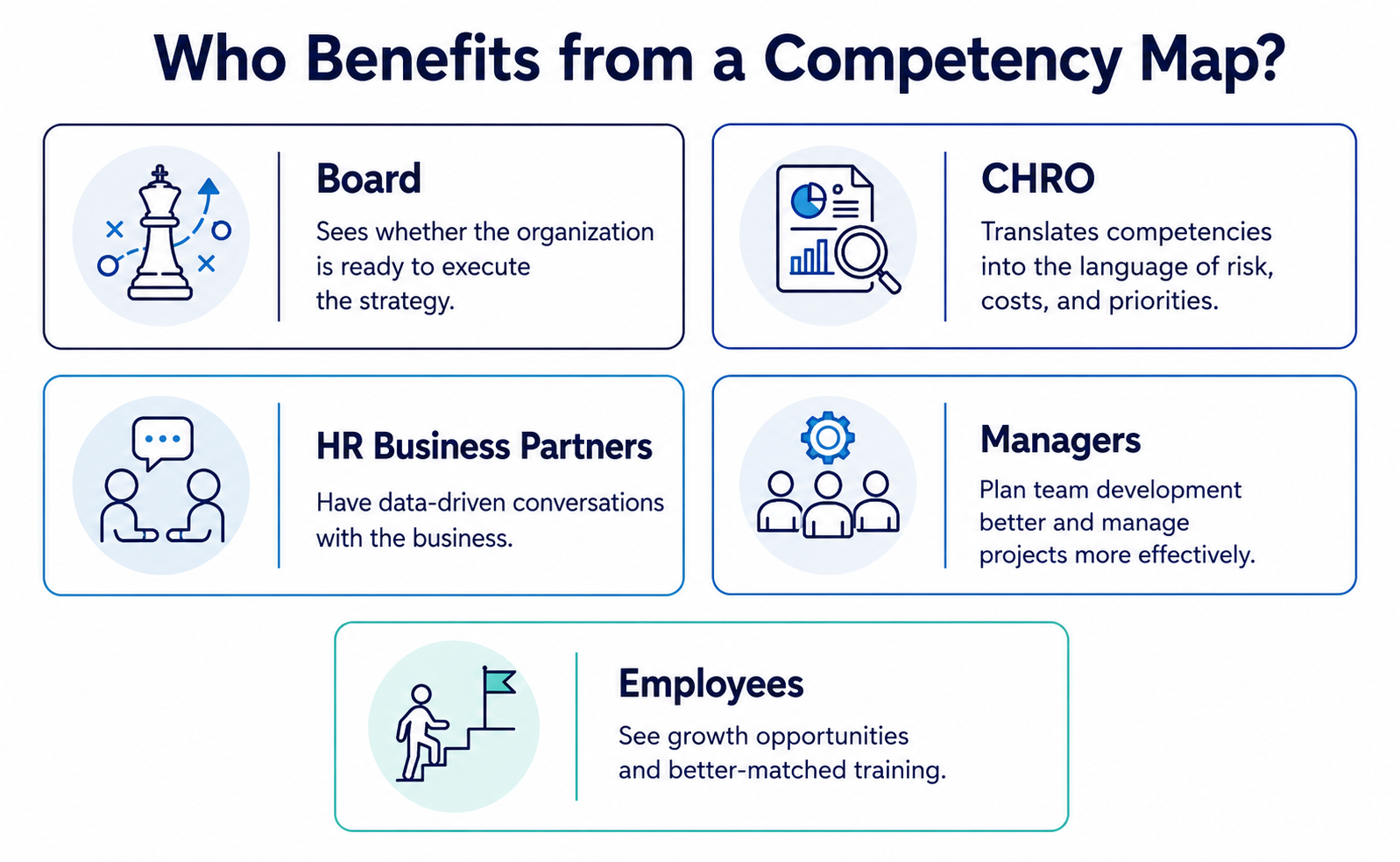
For the board, a competency map provides a clearer picture of risk and the organization's readiness to execute its strategy. It reveals the company's strengths, areas requiring investment, and gaps that could impact the pace of growth.
For CHROs, it's a tool that strengthens discussions with the business. It allows them to better justify development investments, plan HR initiatives, and demonstrate the impact of competencies on organizational goals.
For HR Business Partners, a competency map offers practical support in discussions with managers. It helps transition from general development needs to concrete actions.
For managers, it means better team knowledge, greater clarity of expectations, and easier planning for people development.
For employees, it can mean more conscious development paths, better-matched training, and greater visibility of their competencies within the organization.
Summary
A competency map helps an organization see if it has the competencies needed to execute its strategy. It reveals where gaps exist, where potential lies, which competencies are critical, and where risks might emerge.
For CHROs and the board, it's a crucial decision-making tool. It enables better planning for development, succession, reskilling, recruitment, and transformation. It also helps discuss HR in business terms: priorities, risks, costs, and the organization's readiness to act.
Technology, such as SAP SuccessFactors and Talent Intelligence Hub, can support this process by helping maintain competency data in a more consistent and up-to-date form. However, the ultimate goal remains: to make better decisions about people and the organization's future.
Want to check which HR areas need to be streamlined before implementing automation and AI? Fill out HCM AI Readiness Scorecard and see where your organization has the greatest potential for improvement.

Ludwik Bogdański is a certified expert with more than 15 years of experience in running and implementing SAP systems integration projects, covering both client implementations and cloud projects, including SAP SuccessFactors and SAP Business Technology Platform (BTP). He specializes in the migration and transformation of SAP systems, providing the highest quality and knowledge necessary for the most complex and demanding projects. During his career, he conducted numerous trainings at SAP Training Centers in Poland and Europe, sharing practical knowledge and best practices. He currently works with the Ensis Technology team, supporting companies in the digital transformation of the HR area. Its key specializations are: • Implementation of SAP S/4HANA and SAP SuccessFactors • Project management according to SAP Activate and PRINCE2 methodologies • Integrations of SAP systems
Latest Articles
A good benefits process begins when employees don't have to ask HR what they are entitled to. They can see their own offer, know the deadlines, and understand what happens after they make a selection.
Recurring payroll adjustments are a sign that an organization is catching exceptions in data, decisions, or information flow too late. This article explores how to increase process predictability and reduce manual reconciliations before month-end closing.
Why is the question "who is available tomorrow?" largely a test of an organization's HR data quality, absence visibility, and decision-making agility? This article shows how SAP SuccessFactors helps organize employee data, absences, working time, and analytics so managers can react more quickly to changes in work schedules.