

Waiting for a formal resignation is the most expensive strategy, because the warning signs of departure are visible in HR systems much earlier. Instead of reacting after the fact, organisations should connect the dots between declining engagement and higher absenteeism to anticipate a crisis before it happens. The real challenge is not a lack of data, but the willingness to act on it before a sudden staffing gap paralyses the team.
Signals of turnover usually appear long before the decisions they should trigger. And that is one of the most underestimated problems in HR.
The warning signs are there. The reports are there too. And yet the issue often does not get properly acknowledged until a key employee leaves, a manager scrambles to find a replacement, and the team tries to maintain momentum with reduced capacity.
So the problem is not simply a lack of information. More often, it is that the information was not turned into action early enough.
In most cases, the signs were already visible: declining engagement, heavier workloads, rising absenteeism, deteriorating team dynamics, a lack of internal movement, or changing employee sentiment. Each of these signals on its own may seem harmless. Together, they begin to form a pattern that is not worth ignoring.
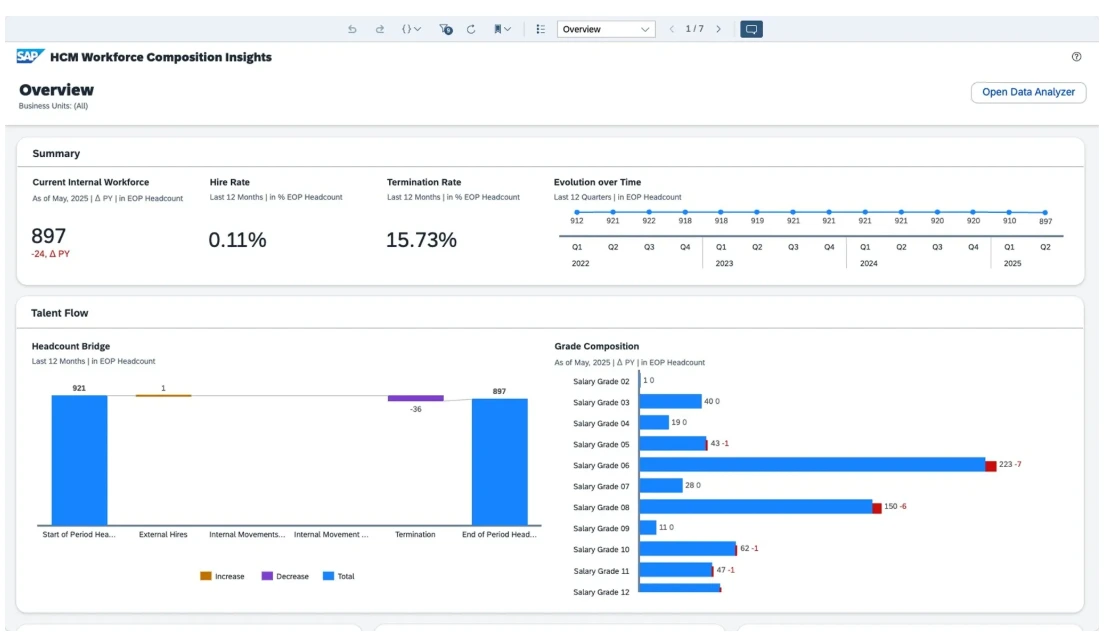
That is why turnover should be viewed more broadly than simply as a retention issue. It is a topic that affects decision quality, operational predictability, and an organisation’s ability to respond proactively.
Signals also emerge around compensation, as a lack of consistency and transparency quickly starts to create tension. I explore this topic in more detail in the article: Can a transparent compensation policy lead to better budget control, fewer tensions, and greater trust?
In many companies, the data needed to identify turnover risk earlier already exists. The problem is that too often it ends up as material for a report, and too rarely triggers a real response.
Why companies spot turnover risk too late
An employee’s departure is rarely the beginning of the problem. More often, it is the moment when the problem becomes visible to everyone.
Before someone leaves, something usually starts to shift. Tension rises, the team operates under increasing pressure, absenteeism begins to grow, or engagement starts to decline. These are not dramatic warning signs yet. But that is exactly how problems usually begin: not as a single event, but as a series of small signals.
In many organisations, however, these signals are not viewed together. Data is scattered, reports are created in different places, and decisions are based on whatever appears most urgent at a given moment. Sometimes the issue is not even a lack of data, but the lack of ownership for responding. I explore this mechanism in more detail in the article: Half the company is waiting for a decision. Who is meant to make it?
The result is simple: the organisation realises it has a problem only when the effects are already being felt. At that point, the turnover rate shows that something has happened, but it still does not reveal where the next problem may emerge.
From a CHRO’s perspective, the cost of this approach rises quickly. A delayed response means greater operational pressure, more difficult conversations with the business, heavier strain on teams, and less predictability.
In most cases, the real issue is the lack of a single, coherent view of the situation and its consequences.
A report alone is no longer enough
Reporting on the past is necessary. Without it, it is difficult to talk about control. The problem begins when the report becomes the end of the process rather than its starting point.
A report shows what has already happened. People Analytics helps reveal what is only just beginning to build.
Monthly or quarterly reports are useful for organising the past, but they rarely help organisations respond at the right moment. In practice, this means the company becomes aware of the problem only when its effects are already visible in the pace of team operations, the burden on managers, or the quality of collaboration.
That is why it becomes so important to connect data from different HR areas: headcount, absenteeism, performance, organisational changes, and engagement. Without one shared view, even a perfectly sound report can do little more than describe the chaos well. This topic is explored further in the article: Zero data risk: How does “one source of truth” protect against management paralysis?
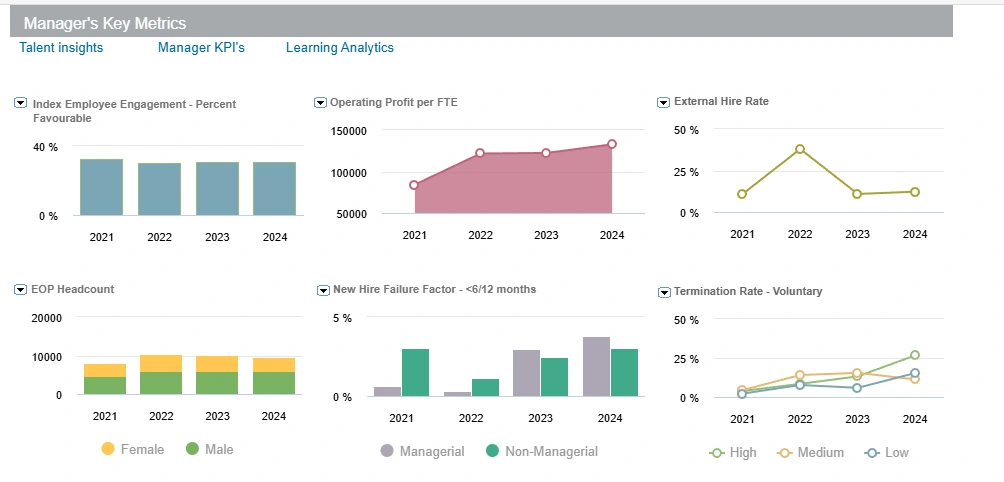
In environments such as SAP, data from different HR areas can be combined in ways that make it easier to identify relationships, recurring signals, and areas that require attention. Working with live HR data allows organisations to analyse the situation more broadly than through the lens of a single report. This broader perspective is what gives analytics real business value.
Which signals are worth connecting?
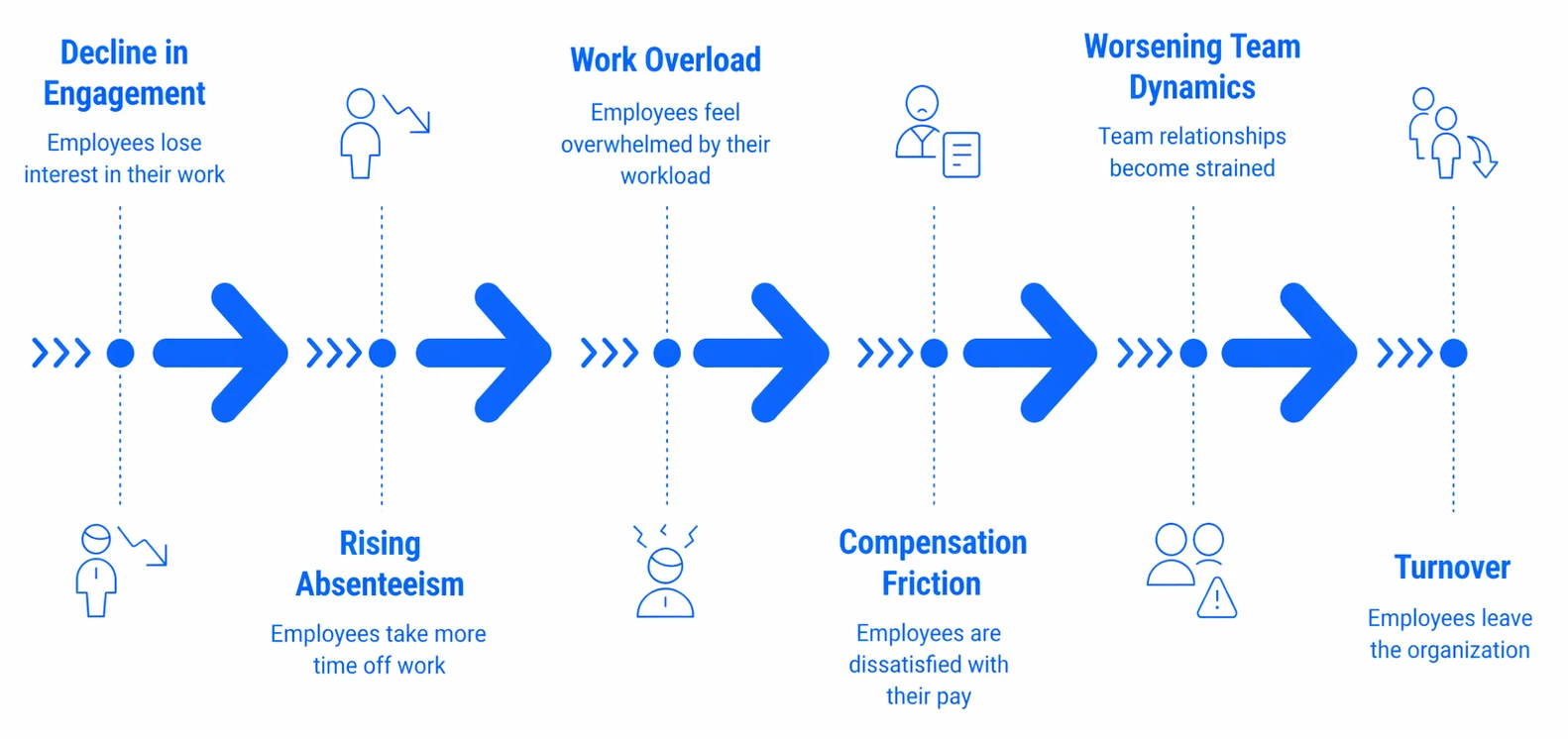
Turnover risk can rarely be captured through a single metric. The clearest picture emerges when several signals begin to form one coherent pattern.
In practice, it is worth monitoring, among other things:
- changes in absenteeism,
- elevated turnover within a specific team,
- performance review results,
- signs of declining engagement,
- changes in team structure,
- a concentration of organisational changes over a short period of time,
- deviations in data relating to specific employee groups.
Viewed in isolation, these factors may seem harmless. Together, however, they begin to reveal a clear direction.
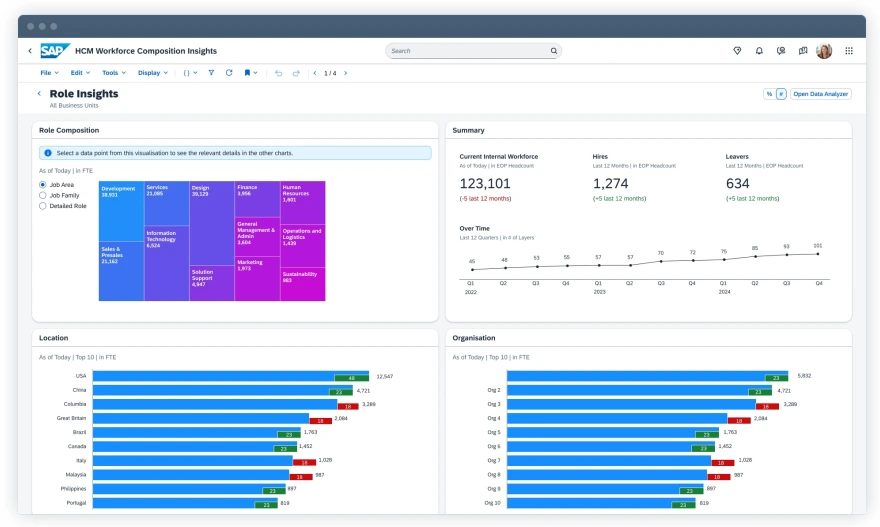
That is why HR analytics has an advantage over traditional reporting. It does not stop at a single metric, but makes it possible to see the relationships between several developments at the same time.
In many organisations, this data already exists. The problem is not that it is missing, but that it is not analysed together and does not lead to a shared conclusion.
Where reporting ends and decision-making begins
A report, in itself, changes nothing. It only becomes valuable when it leads to a decision.
HR data analysis should not end with the question, “What happened?” Much more important are questions such as: where is risk increasing, which teams require closer attention, is a recurring pattern emerging, which signals are one-off incidents, and which are beginning to form a trend?
Effectiveness depends on a clear division of roles. The greatest decision-making paralysis emerges in a kind of no man’s land, where analytics provides data, but no one feels responsible for turning it into action. HR often avoids stepping into a manager’s area of responsibility, while managers may treat system-generated signals as theoretical reports that do not reflect their everyday challenges.
That is why it is worth defining the boundaries clearly. The role of People Analytics is to provide concrete context and indicate, for example, that the correlation between overtime and unused leave in a given department has reached a level that statistically signals potential departures. However, the manager remains the owner of the response. For them, the data functions as an early warning system; it is their responsibility to verify the real cause and decide whether the right response is an honest conversation with the team or a shift in project priorities. If an analytical signal is not followed by clearly assigned responsibility for action, People Analytics remains little more than an accurate diagnosis of problems that were not prevented in time.
HR analytics as an early warning system
HR analytics is often reduced to reporting. That is too narrow an approach.
It becomes valuable when it helps identify a pattern of signals before the problem becomes obvious to the entire organisation. The goal is not another report, but an earlier understanding that, in a specific team, the following are beginning to rise:
- tension,
- absenteeism,
- or the risk of turnover.
This allows HR to name the problem earlier, while giving the business more time to respond.
This perspective is also reflected in the article: How do goals ensure the execution of business strategy?
From signal to action
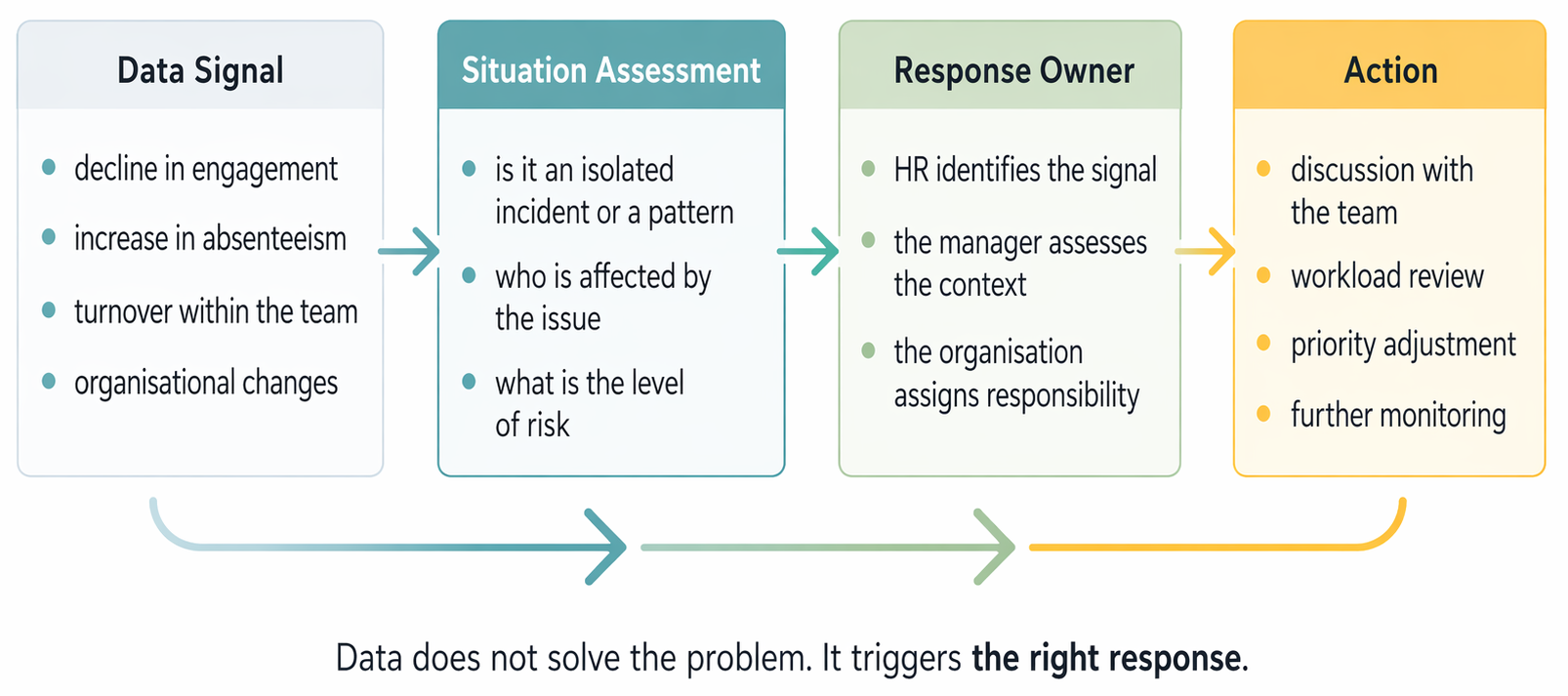
A signal in the data alone is not enough. Someone still needs to assess it, place it in context, and decide what to do next.
Sometimes that means a manager-led conversation and a calm review of the team’s situation. Sometimes it means looking at workload distribution. In other cases, it means checking whether the issue affects one individual or is beginning to spread across a broader part of the unit. Spotting the signal earlier simply creates more options and makes it possible to act without the pressure that usually appears once the issue is already out in the open.
For this to work, however, technology alone is not enough. Organisations also need shared definitions of key metrics, regular data review, and clear ownership of the response. Without that, even an accurate signal can easily get lost along the way.
How the CHRO role is changing
When HR starts identifying risk earlier, its role begins to shift.
Instead of functioning primarily as a unit that reports on the past, HR moves towards becoming a strategic partner capable of signalling risks earlier — risks that affect people, operational pace, and organisational stability.
This means:
- greater predictability for the business,
- better conversations with leaders,
- more informed management of workforce-related risk,
- and stronger data-driven decision-making.
Well-structured HR analytics helps organisations spot risk earlier and avoid acting only after the fact.
Summary
Organisations do not need a crystal ball today. They already have data that, if used properly, can help them identify turnover risk earlier.
Waiting for a formal resignation before taking action is now the most expensive HR strategy. Most organisations already have all the information they need in their systems to anticipate a crisis before it happens. The real skill, however, lies not in collecting numbers, but in having the confidence to draw conclusions from them and turn them into concrete decisions.
Used well, analytics does not provide full control over the future, but it does offer something far more useful: an earlier point of intervention.
If you want to assess the maturity of your key HR processes and see what needs to be improved in your organisation, complete the HCM AI Readiness Scorecard. At the end, you will receive a 6–12 month roadmap and a PDF summary for the Management Board.

Ludwik Bogdański is a certified expert with more than 15 years of experience in running and implementing SAP systems integration projects, covering both client implementations and cloud projects, including SAP SuccessFactors and SAP Business Technology Platform (BTP). He specializes in the migration and transformation of SAP systems, providing the highest quality and knowledge necessary for the most complex and demanding projects. During his career, he conducted numerous trainings at SAP Training Centers in Poland and Europe, sharing practical knowledge and best practices. He currently works with the Ensis Technology team, supporting companies in the digital transformation of the HR area. Its key specializations are: • Implementation of SAP S/4HANA and SAP SuccessFactors • Project management according to SAP Activate and PRINCE2 methodologies • Integrations of SAP systems
Latest Articles
A good benefits process begins when employees don't have to ask HR what they are entitled to. They can see their own offer, know the deadlines, and understand what happens after they make a selection.
Recurring payroll adjustments are a sign that an organization is catching exceptions in data, decisions, or information flow too late. This article explores how to increase process predictability and reduce manual reconciliations before month-end closing.
Why is the question "who is available tomorrow?" largely a test of an organization's HR data quality, absence visibility, and decision-making agility? This article shows how SAP SuccessFactors helps organize employee data, absences, working time, and analytics so managers can react more quickly to changes in work schedules.